Las Vegas's apartment market has genuinely flipped over the past two years. After a period of rapid, pandemic-era rent growth driven by population gains and limited inventory, Southern Nevada added roughly 1,464 multifamily units in the first quarter of 2026 alone, with 6,116 additional units under construction across the valley. Average asking rents have crept up only modestly, to around $1,465 a month, and multifamily vacancy has climbed into the 5.4% to 9.5% range depending on the data source a market that's shifted decisively from landlord-favored toward something closer to balanced, with renters now genuinely comparison-shopping across a deep pool of newly built communities. For property owners, that shift has changed what smart property technology is actually for: less a premium amenity to justify higher rent, and increasingly a retention tool to avoid losing tenants to the lease-up down the street.
Local property management analysis has been direct about the practical implication of this supply wave: 2026 is a year to defend occupancy rather than chase rent, since an empty unit at an aspirational price loses considerably more money than an occupied unit at a realistic one. In a market with this much competing new inventory, an aggressive renewal increase is one of the fastest ways to hand a tenant directly to a newer, better-amenitized property down the street. This dynamic reframes the entire calculation around smart property technology investment: rather than asking whether a given upgrade justifies a rent premium, owners are increasingly asking whether it meaningfully reduces the turnover cost cleaning, marketing, leasing fees, and vacancy days that eats directly into returns in a market this competitive.
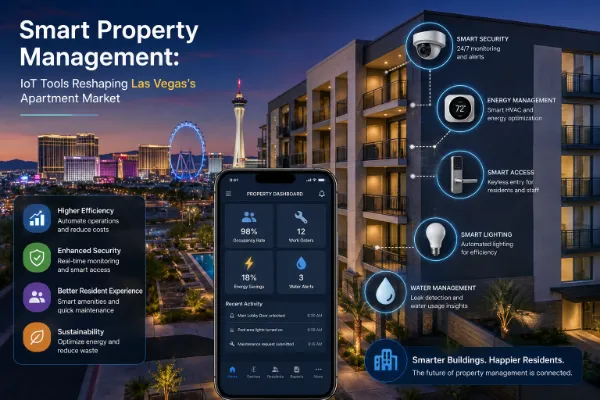
Across Las Vegas's newer apartment communities, particularly those competing in supply-heavy submarkets like Summerlin West and Henderson, a fairly consistent smart property technology package has emerged as close to standard rather than differentiating:
- Smart leak detection, given the significant cost of water damage claims and the fact that Las Vegas's desert climate makes plumbing failures rather than weather-related water intrusion the dominant water damage risk category locally, distinct from what a wetter climate market would prioritize.
- Keyless, app-based access control, increasingly expected by the relocation renters that Las Vegas property managers describe as some of the strongest tenants in the current market professionals moving from other states who arrive with existing expectations around this kind of technology from wherever they relocated from.
- Submetered utility billing, particularly relevant given how directly summer cooling costs affect a Las Vegas renter's total housing cost, making transparent, usage-based billing a genuine differentiator in a market where tenants are actively comparing total cost of occupancy, not just base rent, across competing properties.
- Smart thermostats and occupancy-responsive HVAC, carrying outsized value in a desert climate where cooling represents a disproportionate share of both the property's common-area energy cost and the tenant's own unit-level utility expense.
Unlike California markets covered elsewhere on this site, Nevada has no statewide rent control framework comparable to San Jose's or San Diego's local ordinances, and Las Vegas itself hasn't adopted a comparable local rent stabilization program. This absence of rent control changes the smart property technology calculation in a genuinely different direction than in a rent-controlled market: without a capital improvement pass-through cap limiting how much of a technology investment an owner can recover through rent, Las Vegas landlords have more direct pricing flexibility to fold smart property upgrades into market-rate rent. In practice, though, the current supply-heavy, renter-favorable market conditions are exerting a similar disciplining effect on pricing that rent control does in other markets even without a regulatory cap, owners face real competitive pressure not to overprice technology-enhanced units given how many comparable, newly built alternatives renters can choose from instead.
Nevada has approved more than $64 million in housing funding through the state's attainable housing programs, expected to support development of more than 1,200 multifamily rental units statewide, including projects in Clark County and Henderson. This state-backed development activity adds to the broader supply wave shaping the current market, and it's worth noting that attainable and affordable housing developments funded through this kind of state program increasingly incorporate baseline smart property technology particularly submetering and leak detection as part of standard construction specifications, reflecting how thoroughly this technology category has moved from a luxury differentiator into an expected baseline across most new multifamily construction, regardless of the specific price point a given property targets.
For owners of Las Vegas apartment communities built before this current construction wave, the practical pressure is genuinely direct: competing against newly delivered communities with smart property technology built in from the start requires either a meaningful retrofit investment or accepting a structural disadvantage in a market where renters have unusually deep alternatives to choose from. Given the absence of Nevada rent control constraints on capital improvement recovery, owners of older properties generally have more pricing flexibility to justify a retrofit investment than an equivalent owner in a rent-controlled California market would but that flexibility only matters if the local market conditions actually support charging a premium, and in a market this competitive, that's a genuinely open question property by property rather than something an owner can assume applies uniformly across the valley.
Property owners evaluating smart property technology vendors in Las Vegas's current environment should weigh a few considerations specific to the market's conditions: given how directly retention economics matter right now, prioritizing platforms with demonstrated impact on turnover reduction and renewal rates over platforms marketed primarily around rent-premium justification makes more sense given current market dynamics. Given the desert climate's specific water damage risk profile, leak detection systems should be evaluated specifically for plumbing failure detection rather than the storm and weather-intrusion-focused systems more common in wetter markets. And given how price-sensitive the current renter pool has become amid rising vacancy, technology investments that reduce total occupancy cost for tenants like submetering and smart thermostats that lower actual utility bills tend to resonate more directly with today's comparison-shopping renter than purely convenience-oriented features that don't affect the tenant's bottom-line cost.
Las Vegas property managers have specifically flagged relocation renters people moving from other states, often coastal metros with considerably higher costs of living as an unusually strong and consistent tenant category locally, tending to have solid incomes, preferring twelve-month leases while learning the valley, and frequently renewing once they realize how much housing their money buys locally compared to where they moved from. This tenant profile matters for smart property technology decisions specifically because relocation renters arrive with technology expectations calibrated to whatever market they left, often a market with more mature smart property technology adoption than a legacy Las Vegas property might currently offer making this tenant segment a particularly technology-expectant audience for owners specifically trying to compete for and retain this category of renter.
Frequently asked questions
Toward renters. With 6,116 units under construction and vacancy climbing into the 5.4% to 9.5% range depending on the data source, the market has moved from the landlord-favored conditions of recent years toward something closer to balanced or renter-favorable.
No. Unlike California markets, Nevada has no statewide rent control framework, and Las Vegas has no comparable local rent stabilization ordinance, giving owners more direct pricing flexibility, though current market competition still disciplines pricing in practice.
Smart leak detection, keyless app-based access control, submetered utility billing, and smart thermostats with occupancy-responsive HVAC have all become close to standard, particularly in supply-heavy submarkets like Summerlin West and Henderson.
Given the desert climate, plumbing failures rather than weather-related water intrusion are the dominant water damage risk locally, making leak detection technology a distinct priority compared to markets where storm-driven water damage is more common.
More than $64 million has been approved through Nevada's attainable housing programs, expected to support development of more than 1,200 multifamily rental units statewide, including projects in Clark County and Henderson.
They're tenants moving from other states, often coastal metros, who tend to have strong incomes and arrive with technology expectations calibrated to markets with more mature smart property adoption, making them a particularly technology-expectant tenant segment.
Related articles

 Construction & Real Estate