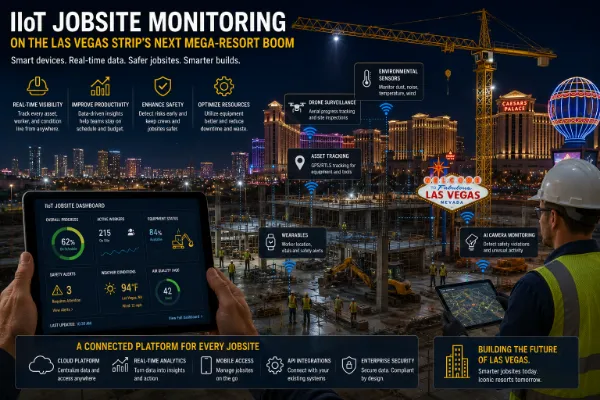
On July 7, 2024, Las Vegas hit 120 degrees Fahrenheit, a record that made national news for a single blistering afternoon. What made fewer headlines was the toll behind that number: the Clark County Coroner's Office later associated more than five hundred deaths with the extreme heat that summer, a scale that pushed Nevada regulators to do something few states have done. Effective April 29, 2025, Nevada's heat illness prevention standard, formally numbered R131-24AP, became enforceable, requiring any employer with ten or more workers to conduct a hazard analysis wherever a majority of employees face heat exposure for more than thirty minutes of any sixty-minute work period. For a Las Vegas construction industry that has spent the past several summers pouring concrete and framing towers at temperatures where asphalt itself can reach 145 degrees, that regulation has turned worker heat monitoring from a nice-to-have safety initiative into a documented legal obligation, and it is quietly reshaping how contractors think about wearable and sensor technology on the jobsite.
Nevada's regulation is specific about what counts as compliance. Employers identified as facing genuine heat risk must develop a written safety plan addressing water access, scheduled rest breaks, cooling measures, worker training, and emergency response procedures, all of it documented rather than assumed. Employees working in fully climate-controlled environments are exempt from the heat-specific requirements, though they still fall under general workplace hazard protections. Nevada OSHA has structured enforcement to reward proactive compliance: employers working with the agency's Safety Consultation and Training Section during this process are exempt from regular inspections for that period, an incentive clearly designed to push contractors toward documented prevention rather than reactive compliance after an incident.
For a Las Vegas general contractor, the practical challenge is less about understanding the rule and more about proving compliance across a workforce that is often outdoors, mobile, and working in conditions that change hour to hour. A written plan on paper does not demonstrate that a specific worker on a specific afternoon was actually monitored for early signs of heat stress, which is precisely the gap wearable sensor technology is positioned to fill.
The evidence base for this technology, while not yet built around Las Vegas-specific case studies, is compelling enough that Nevada contractors are actively evaluating it as the new rule takes effect. Industry case studies from other high-heat, high-workforce construction environments have documented sizable results: one major developer overseeing more than fifteen thousand workers implemented AI-paired smartwatches that monitor heart rate and skin temperature in real time, and recorded a sixty-three percent reduction in on-site medical emergencies within a year of deployment. Given that OSHA estimates the average cost of a single heat-related medical incident at nearly eighty thousand dollars once lost work hours and liability exposure are factored in, the financial case for wearable monitoring stacks up quickly for any contractor running a workforce of meaningful size through a Las Vegas summer.
The mechanics are straightforward: a wrist-worn or vest-mounted sensor tracks heart rate and skin or core temperature continuously, flagging a supervisor before a worker's physiological signs cross into dangerous territory rather than waiting for visible symptoms like confusion or collapse, by which point the worker is already in a medical emergency. That early warning window, minutes rather than none, is the entire value proposition, and it maps directly onto exactly the kind of documented, proactive monitoring Nevada's new regulation now expects employers facing genuine heat risk to demonstrate.
| Compliance Requirement | Traditional Approach | Sensor-Enabled Approach |
|---|
| Worker heat exposure monitoring | Visual supervisor checks and self-reporting | Continuous heart rate and temperature tracking with automated alerts |
| Documentation for compliance | Paper logs of breaks and water access | Timestamped sensor data demonstrating individual worker monitoring |
| Emergency response trigger | Reactive, after visible symptoms appear | Proactive, before physiological thresholds are crossed |
The construction boom driving this need is itself worth putting in context. Southern Nevada has spent recent years running an unusually dense pipeline of large-scale projects simultaneously, from Strip resort expansions to master-planned residential communities pushing into the outer edges of the Valley, and nearly all of that work happens outdoors during a season where indoor climate control simply is not an option. That concentration of active outdoor construction work, layered on top of a climate that now regularly produces sustained triple-digit stretches lasting months rather than weeks, is exactly the combination that makes Las Vegas a proving ground for heat safety technology in a way that construction markets in more temperate regions never need to become. A wearable heat monitoring platform that performs reliably through a Las Vegas summer has effectively been tested under some of the most demanding conditions the industry can offer.
Insurance and liability considerations add another layer of business logic beyond regulatory compliance alone. A documented, sensor-based heat monitoring program gives a contractor a materially stronger position in the event of a workers' compensation claim or litigation following a heat-related incident, since timestamped physiological data showing a worker was actively monitored, and that an intervention was triggered at the appropriate threshold, is a fundamentally different evidentiary position than a paper log claiming breaks were offered. Some insurers are beginning to factor documented safety technology adoption into commercial liability pricing for high-risk outdoor trades, which means the wearable investment increasingly pays for itself through reduced premiums in addition to reduced incident costs.
- Conduct the required job hazard analysis before selecting technology, since the specific job classifications and exposure durations identified in that analysis should drive which crews get prioritized for wearable monitoring first.
- Pilot wearable heat sensors on a single crew or project before a company-wide rollout, since worker buy-in matters enormously and initial resistance tied to privacy concerns tends to ease once the safety benefit becomes visible in practice.
- Pair sensor data with existing cooling station and hydration protocols rather than treating wearables as a replacement for physical safety infrastructure already required under the rule.
- Work with Nevada OSHA's Safety Consultation and Training Section during initial compliance planning, since that engagement provides both technical guidance and a temporary exemption from standard inspections.
Worker privacy concerns are the most immediate hurdle, since continuous physiological monitoring understandably raises questions about how that data gets used, stored, and whether it could factor into unrelated employment decisions, concerns that generally ease once companies are transparent that the data exists solely to trigger safety interventions. Battery life and durability present a more mundane but persistent challenge, since any wearable deployed on an active construction site needs to survive dust, impact, and, ironically, the same extreme heat it is monitoring for, without requiring constant charging or replacement mid-shift. Cost remains a real barrier for smaller subcontractors operating on thin margins, even with a compelling per-incident cost avoidance case, since the upfront investment in devices and a monitoring platform is a harder sell for a ten-person crew than for a developer managing thousands of workers across multiple sites. Finally, integrating wearable data into a broader jobsite safety and documentation workflow, rather than running it as a disconnected app on a supervisor's phone, requires more IT coordination than many construction firms are used to budgeting for.
Expect wearable heat monitoring adoption to accelerate significantly as Nevada OSHA enforcement matures and more contractors see peers cite it as part of their documented compliance plans. Drone-based site surveying and progress tracking is a parallel trend gaining traction across the Valley's active mega-projects, giving developers and lenders remote visual verification of construction progress without requiring site visits, a capability with obvious appeal given how spread out and numerous major developments are across the region at any given time, and one that pairs naturally with the aerial infrastructure already discussed in our coverage of LVMPD's drone program, even though the two use cases serve entirely different purposes. As more of this data accumulates, expect construction technology platforms to increasingly connect jobsite safety monitoring directly with project management and insurance underwriting, turning what starts as a regulatory compliance tool into a broader operational and even actuarial asset for the companies that adopt it early. Businesses evaluating construction technology partners can browse the Las Vegas IoT companies directory, and ongoing coverage is tracked in the Construction and Real Estate section. For an industry that has spent decades treating heat as an unavoidable cost of doing business in Southern Nevada, turning it into a measured, documented risk is arguably the single biggest technology shift construction in this market has seen in years.
Frequently asked questions
Effective April 29, 2025, R131-24AP requires Nevada employers with ten or more workers to conduct a hazard analysis wherever a majority of employees face heat exposure for more than thirty minutes of any sixty-minute period, and to implement a written safety plan covering water, rest breaks, cooling, training, and emergency response.
The regulation followed Las Vegas's hottest summer on record in 2024, including a 120-degree day on July 7, which the Clark County Coroner's Office associated with more than five hundred heat-related deaths that year.
Case studies from high-heat construction environments elsewhere have shown wearable sensors monitoring heart rate and skin temperature can reduce on-site medical emergencies by as much as sixty-three percent, with OSHA estimating the average cost of a heat-related medical incident at nearly eighty thousand dollars.
No, employees working in fully climate-controlled environments are exempt from the heat-specific requirements of R131-24AP, though they remain covered by general workplace hazard protections.
Cost remains a significant barrier for smaller subcontractors, alongside worker privacy concerns about continuous physiological monitoring and practical challenges around battery life and durability in dusty, high-heat jobsite conditions.
Employers who engage with Nevada OSHA's Safety Consultation and Training Section during compliance planning receive technical guidance and are exempt from regular inspections during that engagement period, incentivizing proactive rather than reactive compliance.
Related articles


 Construction & Real Estate