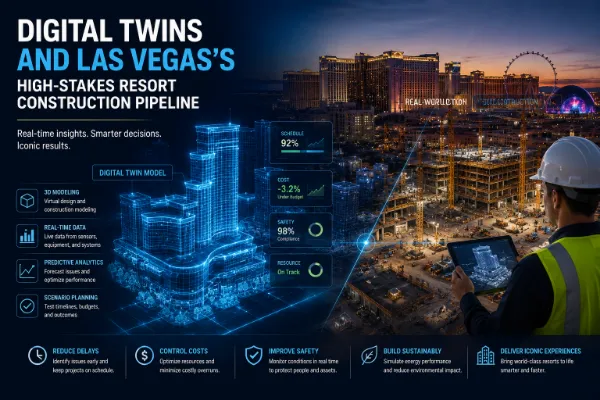
Two of the most ambitious construction projects on the Las Vegas Strip right now sit almost directly across from each other, both racing toward deadlines that can't slip. Hard Rock Las Vegas, rising on the former Mirage site, reached 36 completed stories on its 42-story Guitar Hotel tower by mid-2026, part of an approximately $2.5 to $4 billion resort complex targeting a late 2027 opening. Down the Strip at the former Tropicana site, the Las Vegas Athletics' new $1.7 billion, 33,000-seat ballpark broke ground in June 2025, with Bally's simultaneously planning a 3,000-room integrated resort surrounding the stadium. Total capital deployment across the Strip's top current megaprojects runs somewhere between $36 and $40 billion through 2030 — a construction boom happening at a scale and pace that makes disciplined, IoT-driven jobsite management less a competitive advantage than a basic operational necessity.
The current wave of Strip megaproject construction is notably concentrated in complex, technically demanding builds rather than straightforward tower construction. Hard Rock's Guitar Hotel isn't a conventional rectangular tower — its distinctive guitar-body-and-neck silhouette introduces structural and logistics challenges that a standard high-rise doesn't face, requiring construction sequencing and crane logistics tailored specifically to the building's irregular geometry. The Athletics' ballpark presents its own genuinely unusual engineering problem: a fully climate-controlled, enclosed stadium designed to make outdoor-style baseball viable in a market that regularly sees summer temperatures above 110 degrees, with construction milestones through 2026 including completing the steel superstructure and installing what's been described as a 360-degree outfield scoreboard rivaling Tokyo Dome's. Neither project is the kind of repeatable, standardized build that jobsite monitoring templates from a typical suburban office park translate cleanly onto.
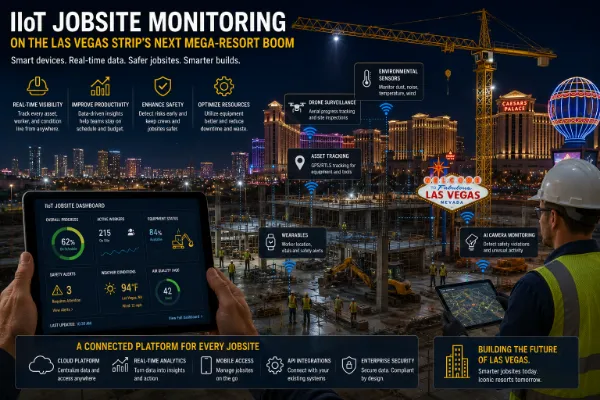
For megaprojects of Hard Rock's and the Athletics ballpark's scope, jobsite IoT monitoring concentrates on a few categories that matter disproportionately given the projects' complexity and public visibility. Structural monitoring sensors track vibration, tilt, and settlement throughout construction, particularly important for a tower like the Guitar Hotel where the building's irregular shape creates load distribution patterns a standard rectangular structure wouldn't need to account for as closely. Equipment tracking and theft prevention matter enormously given the sheer volume of specialized machinery required simultaneously across a project spanning dozens of acres — cranes, concrete pumps, and specialized structural steel handling equipment all represent significant capital investment that needs continuous location and utilization visibility. Worker safety monitoring, covered in more depth in this site's broader coverage of construction jobsite IoT, carries particular weight given Nevada's construction safety regulatory environment and the genuinely large workforce these projects require simultaneously — Hard Rock's construction team has emphasized staying on time and on budget through the structural phase, a claim that depends directly on having reliable, real-time visibility into exactly where the project stands at any given moment rather than discovering delays only after they've already compounded.
The Tropicana site illustrates a coordination challenge specific to this construction cycle: the Athletics ballpark and Bally's surrounding integrated resort are being developed on essentially the same 26-plus-acre footprint simultaneously, by different developers working toward related but independently managed timelines. This kind of adjacent, overlapping megaproject development — similar in structure to the coordination challenge covered in this site's coverage of San Jose's BART tunnel construction happening near multiple private developments — makes shared data visibility between projects genuinely valuable rather than optional. A ground settlement issue or utility conflict discovered during ballpark construction has direct implications for Bally's adjacent resort construction, and vice versa, which argues for at least some level of data-sharing coordination between the two projects' monitoring systems, even though they remain under entirely separate ownership and management.
Few construction markets anywhere face the level of public and media scrutiny that Las Vegas Strip megaprojects do — Hard Rock's construction progress has been documented in local media through regular photo updates tracking specific milestones like floor completion counts, and the Athletics ballpark's construction timeline is followed closely given its significance as the first Major League Baseball venue built directly on Strip resort property. This visibility creates a genuine incentive for contractors to maintain thorough, continuously updated documentation of construction progress, safety compliance, and site conditions — not just for internal project management purposes, but because public and stakeholder scrutiny means any safety incident or significant delay becomes a matter of public record and reputational consequence far faster than it would on a less visible project.
Construction work continuing through Las Vegas summers, when the Athletics' own stadium design explicitly treats 110-degree heat as a design constraint to engineer around, makes heat-related worker safety monitoring a genuinely critical category of jobsite IoT investment rather than a secondary concern. Wearable heat stress monitors and environmental sensors tracking heat index across a jobsite — covered in more depth in this site's broader coverage of workforce safety monitoring — carry real weight on projects of this scale and duration, where thousands of workers are exposed to extended outdoor construction work through some of the hottest sustained summer conditions found in any major U.S. construction market.
Beyond Hard Rock and the Tropicana site redevelopment, the current wave of Southern Nevada megaproject investment spans a genuinely diverse set of infrastructure categories: Brightline West's roughly $12 billion high-speed rail line connecting Las Vegas to the Los Angeles basin, covered in more depth in this site's coverage of Southern Nevada transit infrastructure; the Apex Industrial Park representing more than $8 billion in logistics and manufacturing development; and continued build-out around Formula 1 infrastructure supporting the Las Vegas Grand Prix. Each of these projects carries its own distinct jobsite monitoring requirements, but the aggregate effect is a construction labor and equipment market under genuine strain — with this many major projects competing simultaneously for skilled trades, specialized equipment, and experienced project management talent, jobsite IoT systems that reduce the labor overhead of manual progress tracking and equipment location carry outsized value simply because the alternative, adding more supervisory staff to compensate, runs directly into the same tight labor market driving up costs across every project in the pipeline simultaneously.
For contractors and subcontractors bidding into this wave of Strip megaproject construction, a few practical considerations follow from the scale and visibility of the current cycle: given the deadline pressure both major projects face — Hard Rock's late 2027 opening and the Athletics' 2028 season target — contractors should expect and plan for jobsite monitoring requirements more rigorous than a typical commercial project, with real-time progress tracking increasingly expected as a standard deliverable rather than an optional add-on. Given the adjacent, overlapping nature of development on sites like the former Tropicana property, contractors should also anticipate coordination requirements with neighboring projects' monitoring systems, even when working for an entirely separate developer on an adjacent parcel.
Frequently asked questions
Estimates for the resort complex, including its distinctive 42-story Guitar Hotel tower, range from approximately $2.5 to $4 billion, with the project targeting a late 2027 opening and having reached 36 completed stories on the tower by mid-2026.
It's a fully climate-controlled, enclosed 33,000-seat ballpark specifically engineered to make outdoor-style baseball viable in a market that regularly exceeds 110 degrees in summer, with construction that broke ground in June 2025 and targets the 2028 MLB season.
Total capital deployment across the Strip's top current megaprojects, including Hard Rock, the Athletics ballpark, Bally's surrounding resort, and Brightline West, runs approximately $36 to $40 billion through 2030.
The Athletics ballpark and Bally's planned integrated resort are being developed on essentially the same footprint simultaneously by separate developers, making data-sharing coordination between the two projects' monitoring systems genuinely valuable despite independent ownership.
With construction continuing through Las Vegas summers and one major project explicitly designed around 110-degree heat as an engineering constraint, wearable heat stress monitoring and environmental sensors carry particular weight given the extended outdoor construction work involved.
Yes. Given the intense media and public attention these Strip projects receive, contractors face a genuine incentive to maintain thorough, continuously updated construction and safety documentation beyond what a less visible project might require.
Related articles

 Construction & Real Estate