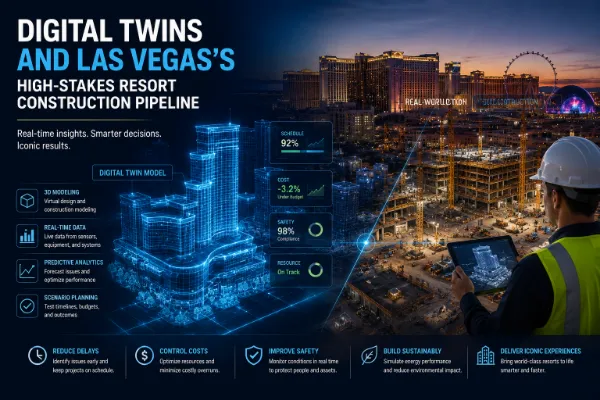
Las Vegas's current construction pipeline includes buildings that genuinely can't be prototyped through trial and error. Hard Rock Las Vegas's Guitar Hotel a 42-story tower shaped, structurally, like an actual guitar body and neck and the Athletics' new ballpark, a fully climate-controlled stadium designed to make outdoor-style baseball viable through 110-degree desert summers, both represent the kind of genuinely novel structural and mechanical engineering challenges where getting the design wrong isn't a minor correction, it's a multi-hundred-million-dollar mistake. Digital twin modeling building a continuously updated digital replica that simulates real-world performance before and during construction has become a practical necessity for projects like these, not a technology trend layered on for marketing purposes.
Total capital deployment across the Strip's top current megaprojects runs approximately $36 to $40 billion through 2030, spanning genuinely novel engineering challenges rather than repeatable, standardized building types. This combination of scale and novelty is exactly the scenario where digital twin technology delivers its clearest value the underlying design risk on a project like the Guitar Hotel or the Athletics ballpark can't be meaningfully de-risked by referencing how a comparable building performed elsewhere, because there isn't a comparable building. Simulation and modeling become the primary tool for validating that an unconventional design will actually perform as intended before billions of dollars in construction capital gets committed to it.
A conventional rectangular tower's structural engineering benefits from decades of comparable precedent engineers know broadly how a building of that shape and height will behave under wind load, seismic activity, and thermal expansion. Hard Rock's guitar-shaped tower doesn't have that precedent to draw on in anywhere near the same depth, which makes digital twin and simulation modeling essential for testing how the building's irregular geometry the narrower "neck" transitioning into the wider "body" shape actually performs structurally under real-world conditions, rather than discovering a problem only once physical construction has already progressed past the point where a design flaw is cheap to fix. This kind of simulation-driven validation is a large part of why Hard Rock's construction team has been able to publicly maintain that the project remains on time and on budget through its structural phase a claim that depends on the design's structural performance having already been thoroughly validated well before the actual concrete and steel went into place.
The Athletics' new stadium presents a different, but equally novel, digital twin use case: engineering a fully enclosed, climate-controlled environment large enough to host an MLB game while managing Las Vegas's extreme summer heat load, all while creating an experience that still feels like outdoor baseball rather than an indoor arena. This requires extensive thermal and airflow modeling simulating how the massive enclosed volume will actually behave under different occupancy levels, outdoor temperature conditions, and mechanical system configurations before committing to a specific HVAC and building envelope design at this unprecedented scale. Getting this wrong wouldn't just mean an uncomfortable stadium; it could mean an unworkable one, given how directly the venue's entire value proposition depends on successfully managing conditions that no comparably sized enclosed sports venue has had to solve in quite this climate.
The former Tropicana site's dual development the Athletics ballpark and Bally's surrounding integrated resort, covered in more detail in this site's coverage of Strip jobsite monitoring creates a genuine digital twin coordination challenge distinct from either project's individual engineering complexity. With two separate developers building on essentially the same footprint simultaneously, digital twin models that can actually exchange data between the two projects construction staging conflicts, shared utility infrastructure, foundation and excavation coordination deliver considerably more value than either developer maintaining an isolated model that doesn't account for what's happening on the immediately adjacent parcel. This mirrors the same cross-project coordination challenge covered in this site's coverage of San Jose's dense, overlapping development pipeline near Diridon Station, and it represents one of the more practically difficult applications of digital twin technology precisely because it requires two independently owned projects to agree on data-sharing protocols neither would necessarily need for a standalone project.
A genuine digital twin's value doesn't end at construction completion for buildings this operationally complex, the model's real long-term payoff comes from continuing to receive live operational data once the building opens, turning the design-phase simulation into an ongoing operational management tool. For the Athletics ballpark specifically, this means the same climate-control modeling used during design should continue informing actual HVAC operation once the stadium is hosting real games under real, variable Las Vegas weather conditions validating whether the engineered system performs as simulated, and providing the operational data needed to fine-tune performance over the venue's actual working life. For Hard Rock's Guitar Hotel, continued structural monitoring feeding back into the original design model provides ongoing verification that the building's unconventional geometry continues performing as engineered, well beyond the point where construction crews have moved on to other projects.
It's worth being direct about where digital twin modeling's value genuinely tapers off for projects this unprecedented: simulation quality depends heavily on the accuracy of the underlying models and assumptions, and for genuinely novel building types without extensive comparable precedent, there's real, irreducible uncertainty that even sophisticated modeling can't fully eliminate. Digital twin technology reduces risk on projects like the Guitar Hotel and the Athletics ballpark; it doesn't eliminate it entirely, and the construction teams on both projects have continued relying on extensive physical testing, phased construction validation, and conservative engineering margins alongside their digital modeling rather than treating simulation as a complete substitute for traditional engineering caution on buildings this far outside established precedent.
It's worth noting a practical, financial dimension to digital twin adoption on projects of this scale that goes beyond pure engineering risk reduction: lenders and capital partners financing multi-billion-dollar, structurally unprecedented projects increasingly expect to see rigorous simulation and modeling documentation as part of their own due diligence process before committing capital. A development team able to demonstrate that a novel design has been thoroughly validated through digital twin modeling, rather than relying purely on traditional engineering sign-off, is often in a stronger position to secure financing on favorable terms for a project genuinely outside established precedent making digital twin investment as much a capital-raising tool as an engineering one for developments at this scale.
As the current wave of Strip megaproject construction continues through 2030, the digital twin and simulation modeling capability being developed and refined on flagship projects like the Guitar Hotel and the Athletics ballpark is likely to filter down into more conventional Las Vegas construction over time engineering firms and contractors who've built genuine expertise validating unprecedented building types on these high-profile projects carry that capability into their next engagement, even a comparatively conventional one. This pattern, where a market's most novel, highest-stakes projects effectively fund the development of modeling capability that later becomes standard practice across the broader industry, is a genuine, if often overlooked, byproduct of a construction boom this concentrated in genuinely unprecedented building types.
Frequently asked questions
Its irregular, guitar-shaped geometry lacks the decades of comparable structural precedent that a standard rectangular tower design can draw on, making simulation-based validation essential for confirming the building will perform as intended before construction commits to the design.
Extensive thermal and airflow modeling is needed to validate that a fully enclosed, climate-controlled stadium can successfully manage Las Vegas's extreme summer heat while still delivering an outdoor-baseball-like experience, a scale and climate combination without direct precedent.
Shared or data-exchanging models between the two independently developed projects can help identify construction staging conflicts, shared utility issues, and foundation coordination problems before they become costly change orders discovered mid-construction.
No. For operationally complex buildings like these, the model's ongoing value comes from continuing to receive live operational data after opening, letting teams validate and fine-tune actual performance against original design simulations.
No. Simulation quality depends on the accuracy of underlying assumptions, and for building types without extensive precedent, real uncertainty remains even with sophisticated modeling, which is why construction teams continue pairing digital twins with physical testing and conservative engineering margins.
Digital twin and simulation expertise developed on flagship projects like the Guitar Hotel and Athletics ballpark is likely to carry over into more conventional local construction projects as engineering firms and contractors apply lessons learned to future engagements.
Related articles

 Construction & Real Estate