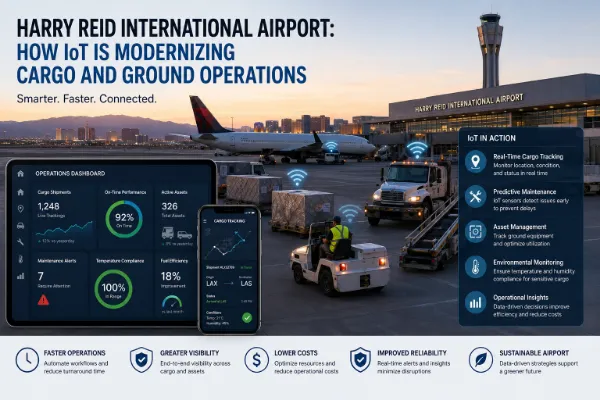
Harry Reid International Airport sits five miles south of downtown Las Vegas and moved more than 213 million pounds of cargo in 2025, alongside nearly fifty-five million passengers, making it one of the busier combined passenger and freight hubs in the American Southwest. What gets less attention than the passenger side is the airport's dedicated air cargo infrastructure, and what gets even less attention than that is how Las Vegas's position at the intersection of Interstate 15, U.S. 93, and U.S. 95 has quietly turned the broader Valley into a distribution node for goods moving between Southern California, Utah, Arizona, and beyond, a role that increasingly depends on IoT-enabled tracking rather than paper manifests and radio check-ins.
Harry Reid's air cargo center, developed through a partnership with Marnell Properties, is a 200,928-square-foot freight and distribution facility built on roughly nineteen acres less than a mile from the main terminal. That kind of dedicated, purpose-built cargo footprint next to an international airport is exactly the environment where modern logistics IoT delivers the clearest return, since freight moving through a facility this size needs real time visibility across handoffs between air carriers, ground handlers, and outbound trucking, rather than a single tracking number that only updates once a shipment reaches its next major checkpoint.
The Valley's highway geometry compounds that advantage. Interstate 15 links Las Vegas directly to the Southern California ports and to Salt Lake City, while U.S. 93 and U.S. 95 extend reach toward Phoenix, Reno, and Albuquerque. A distribution operation based in Las Vegas can realistically reach a large share of the Western United States within a single day's drive, which is precisely the kind of geography that has made the broader region attractive to national logistics and fulfillment operators expanding their western footprint over the past decade.
For a trucking or last-mile delivery operation running routes through the Las Vegas Valley, the practical value of IoT tracking is less about the novelty of GPS location and more about integrating with the traffic intelligence infrastructure the region has already built. As detailed in our coverage of the Regional Transportation Commission's adaptive traffic signal and AI intersection analytics program, connected vehicle data is already feeding directly into how the Valley manages its arterial roads, and fleet operators equipped with modern telematics are effectively already participating in that data ecosystem whether they realize it or not. A delivery fleet that layers its own IoT-based route optimization on top of that existing public infrastructure, rather than relying purely on generic national mapping data, gets a meaningfully more accurate picture of how a Las Vegas Boulevard route behaves on a Saturday night during a major residency show versus a quiet Tuesday morning.
Cold chain monitoring is a second, less visible but equally important use case given the region's climate. Freight moving through outdoor cargo areas or waiting on tarmac during a Las Vegas summer, when ground-level temperatures regularly exceed 110 degrees Fahrenheit, faces genuine spoilage risk for temperature-sensitive cargo ranging from pharmaceuticals to fresh produce bound for the Valley's enormous hospitality food service supply chain. Connected temperature and humidity sensors inside trailers and cargo containers, reporting continuously rather than requiring a manual check at each stop, give logistics operators the kind of early warning that can mean the difference between a delayed shipment and a written-off one.
| Use Case | Sensor or System Involved | Why It Matters in Las Vegas Specifically |
|---|
| Cold chain monitoring | In-transit temperature and humidity sensors | Extreme summer heat creates real spoilage risk for temperature-sensitive cargo moving through outdoor cargo areas |
| Route optimization | Fleet telematics integrated with RTC traffic data | Event-driven traffic surges around the Strip behave very differently from typical commuter congestion models |
| Cargo handoff tracking | RFID and barcode scanning across air-to-ground transitions | A dedicated air cargo center adjacent to the airport creates frequent multi-party handoffs that benefit from real time status updates |
Behind every Strip resort's kitchens, bars, and retail outlets sits a supply chain problem most visitors never think about: keeping a property with tens of thousands of daily guests continuously stocked with fresh food, beverages, and amenities delivered on tight, often overnight windows so deliveries do not interfere with guest traffic. Resort logistics teams increasingly rely on connected inventory and delivery tracking to coordinate these overnight windows precisely, since a delayed produce delivery for a breakfast buffet serving several thousand guests has a much narrower recovery window than the same delay would create for a typical grocery store, and a missed window can mean scrambling to source substitute product from a secondary vendor at a steep last-minute markup. This resort-specific delivery choreography is a genuinely distinct use case from general warehouse logistics, and it is one reason logistics technology vendors serving Las Vegas specifically often need experience with hospitality-scale, time-critical delivery windows that a generic retail distribution background does not fully prepare them for.
Convention and trade show logistics add another layer of complexity unique to this market. The Las Vegas Convention Center and similar venues host enormous, time-boxed logistics events multiple times a year, where exhibitor freight for events drawing well over one hundred thousand attendees needs to arrive, get staged, and get removed within tightly compressed multi-day windows. IoT-based asset tracking for exhibit freight, letting show organizers and drayage companies see exactly where a given shipment sits in the staging process, has become standard practice for the largest shows precisely because the financial penalty for a missed setup deadline is severe and immediate.
- Integrate fleet telematics with RTC's available traffic data feeds rather than relying solely on national mapping APIs, since local signal timing and event data is more current for Valley-specific routing decisions.
- Prioritize cold chain sensors for any route involving outdoor cargo staging during summer months, when temperature exposure risk is highest and least forgiving of delays.
- Build in extra buffer time for major event dates, and use historical connected vehicle data where available to quantify exactly how much extra time specific corridors require during large conventions or residencies.
- Evaluate warehouse and distribution site locations against both highway access and airport cargo proximity, since the two together determine how competitive a Las Vegas-based distribution node can be for time-sensitive freight moving through the broader Southwest.
Extreme heat is the most Las Vegas-specific operational challenge, since it affects everything from vehicle and equipment reliability to the cargo itself, and any IoT monitoring strategy built for other regions needs recalibrated thresholds to account for genuinely higher baseline temperatures for a much larger share of the year. Sensor hardware itself is not immune to this either, since battery-powered tracking devices and temperature sensors mounted on trailer exteriors face accelerated wear in sustained triple-digit heat, meaning device maintenance schedules calibrated for a temperate climate will not hold up well in the Mojave Desert without adjustment.
Event-driven traffic volatility is a related challenge, since a corridor that behaves predictably ninety percent of the time can become severely congested during a major convention, championship fight, or residency show, and static routing models struggle to anticipate that variability without recent, granular traffic data. Labor availability for last-mile delivery also fluctuates with the broader hospitality labor market, since delivery and warehouse work compete directly with resort and casino employment for the same regional workforce. Finally, integrating fleet data across multiple carriers and ground handlers moving freight through a shared facility like Harry Reid's cargo center requires data-sharing agreements and common standards that are not always straightforward to negotiate between competing logistics companies.
Expect continued growth in the Valley's role as a Southwest distribution hub as e-commerce and same-day delivery expectations keep pushing fulfillment operations closer to major population centers with strong highway access. Deeper integration between commercial fleet telematics and RTC's traffic management systems is a logical next step, particularly as more of the underlying signal and camera infrastructure becomes AI-enabled. Autonomous and semi-autonomous last-mile delivery pilots are also increasingly plausible in a region already comfortable hosting mobility experiments, from autonomous shuttle programs to underground tunnel networks connecting Strip resorts, and convention logistics is a natural early testing ground given how repetitive and predictable large-show freight patterns already are compared to general urban delivery. Businesses evaluating logistics technology partners can browse the Las Vegas IoT companies directory, and ongoing coverage of the sector is tracked in the Logistics and Transportation section.
Frequently asked questions
Harry Reid International Airport moved more than 213 million pounds of cargo in 2025, alongside nearly fifty-five million passengers, supported by a dedicated 200,928-square-foot air cargo center developed with Marnell Properties near Terminal 3.
Las Vegas sits at the intersection of Interstate 15, U.S. 93, and U.S. 95, giving distribution operators same-day drive access to Southern California, Utah, Arizona, and other parts of the Southwest, combined with dedicated air cargo infrastructure next to the airport.
Ground-level temperatures regularly exceed 110 degrees Fahrenheit during Las Vegas summers, creating real spoilage risk for temperature-sensitive cargo staged outdoors. Connected temperature and humidity sensors provide continuous monitoring rather than relying on manual checks at each stop.
Fleet telematics can integrate with the Regional Transportation Commission's available traffic data feeds, which reflect real time and event-driven conditions specific to the Las Vegas Valley more accurately than generic national mapping data, especially around major conventions and Strip events.
Extreme heat is the most distinctive challenge, affecting vehicle reliability, cargo integrity, and monitoring thresholds. Event-driven traffic volatility around major conventions and residency shows is a closely related challenge that static routing models struggle to anticipate.
Expect deeper integration between commercial fleet telematics and RTC's AI-enabled traffic management systems, continued growth in e-commerce distribution capacity, and increasingly plausible autonomous or semi-autonomous last-mile delivery pilots given the region's existing comfort with mobility experiments.
Related articles

 Logistics & Transportation