Harry Reid International Airport carried nearly 55 million passengers in 2025 up 5.9% year over year alongside more than 213.7 million pounds of cargo across 586,871 aircraft movements. Those numbers put the airport within striking distance of a genuinely hard ceiling: officials project the facility will become severely capacity-constrained by 2033 as it approaches its estimated maximum capacity of roughly 65 million annual passengers. That looming constraint is what's driving a newly announced multibillion-dollar upgrade plan, and it's also why Harry Reid has become one of the more active real-world testing grounds for airport IoT technology in the country, formally designated as an "Innovation Hub" where new systems get tried out before wider national rollout.
Clark County's Aviation Department has been direct about the stakes: with facilities across the airport's roughly 2,800-acre footprint showing their age, and mega events CES, major conventions, championship boxing, Formula 1, and now the arrival of both an MLB stadium and additional Strip megaresorts covered elsewhere on this site continuing to draw record crowds to Las Vegas, the airport has focused specifically on enhancing its "ability to support" continued operations, in the words of Clark County Aviation Director James Chrisley. The current planning includes a conceptual proposal to add 26 gates to Terminal 1, part of a broader expansion effort responding directly to passenger volume that's already testing the upper edge of the facility's design capacity.
Harry Reid's designation as a testing ground for new airport technology isn't just a marketing phrase the TSA has specifically used the airport to pilot Advanced Image Technology scanning equipment before rolling it out more broadly nationally. These scanners let TSA officers screen travelers and luggage without requiring items to be removed, generating a generalized avatar image of a passenger or bag that flags potential problem items, including components that could be assembled into a weapon, rather than producing the more specific, privacy-sensitive imagery of older scanning technology. Federal security officials testing the equipment at Harry Reid reported that it moved passengers through screening lines measurably faster than the systems it's replacing exactly the kind of real-world throughput data an "innovation hub" designation is meant to generate before a technology gets deployed at airports nationwide.
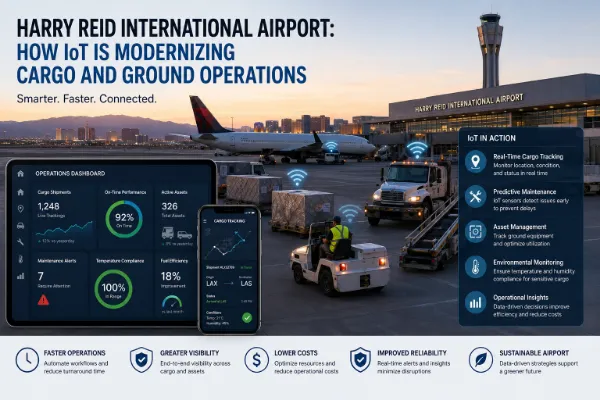
Beyond the passenger-facing TSA pilot program, the broader airport technology trends shaping 2026 apply directly to Harry Reid's own ground and cargo operations. Digital twin technology continuously updated virtual replicas of airport and airspace operations increasingly lets airport operators run "what-if" scenario testing without disrupting live operations, modeling how a gate reconfiguration, a new cargo handling process, or a schedule change would actually perform before committing physical resources to it. Predictive energy management systems, powered by IoT sensors and AI, optimize terminal energy use in real time a genuinely significant consideration for a facility Harry Reid's size operating continuously in the Mojave Desert climate covered in more detail in this site's coverage of Las Vegas cooling infrastructure. And on the cargo side, with e-commerce now representing roughly one-fifth of global air cargo volume, AI-driven analytics increasingly predict cargo flow patterns while blockchain and end-to-end data exchange technologies improve shipment traceability through the handling process.
Harry Reid's terminal areas are already connected by an automated people mover system linking the central terminal with gate concourses infrastructure that depends on the same kind of continuous sensor monitoring and predictive maintenance logic covered in this site's broader coverage of resort infrastructure maintenance, just applied to a transit system moving passengers rather than hotel guests. As the airport's planned expansion adds gates and terminal capacity, this people mover infrastructure will need to scale accordingly, and continuous condition monitoring on the system's mechanical components becomes increasingly important simply because a single system failure affects a much larger share of total passenger flow at a busier, more expanded facility than it would at the airport's current scale.
Harry Reid remains one of only two U.S. commercial airports alongside Reno-Tahoe International that retains slot machines in its passenger terminals under Nevada gaming law, a detail that connects directly to the Nevada Gaming Control Board regulatory framework covered in more detail in this site's coverage of Strip resort smart building technology. Any IoT or connected technology touching these terminal gaming machines falls under the same technical standards and recertification requirements that apply to gaming equipment throughout the state, meaning airport technology upgrades in areas near these installations require the same kind of regulatory coordination a Strip resort's own gaming floor technology changes would need a genuinely unusual compliance consideration that most U.S. airports simply don't have to account for at all.
There's a genuine strategic advantage for Harry Reid in maintaining this innovation hub designation beyond simply hosting individual technology pilots: airports that establish themselves as reliable, well-instrumented testing environments tend to attract continued vendor interest and priority access to new technology ahead of peer airports, since technology providers benefit from working with an airport that has both the operational scale and institutional experience to generate meaningful real-world performance data quickly. Given how directly Harry Reid's own capacity challenges depend on squeezing more throughput from existing infrastructure ahead of physical expansion completing, this steady pipeline of early access to emerging airport technology cargo flow prediction, security screening throughput improvements, energy management systems offers the airport a genuine practical benefit distinct from the technology industry recognition the designation also brings.
For Las Vegas-area businesses relying on Harry Reid for air cargo, the airport's ongoing technology investment and capacity expansion matter directly given how close the facility already sits to its operational ceiling. Businesses shipping time-sensitive freight should expect continued investment in cargo-flow prediction and traceability technology as the airport works to maximize throughput from existing infrastructure ahead of the physical capacity expansion still working through Clark County's planning and construction pipeline a multi-year process that means near-term efficiency gains from better cargo IoT systems matter more than they might at an airport with more readily available physical expansion room.
For Las Vegas-area logistics managers evaluating shipping options as the airport works through this expansion cycle, it's worth engaging directly with cargo handling partners about how capacity constraints during the current buildout period might affect specific shipment types, particularly time-sensitive freight tied to the same convention and event calendar driving the airport's passenger growth. Ground handling reliability during a multi-year expansion project can vary as construction activity affects different terminal and cargo areas at different times, making direct communication with a specific freight forwarder or ground handling company a more reliable planning input than assuming uniform capacity throughout the buildout period.
Frequently asked questions
In 2025, the airport handled nearly 55 million passengers, up 5.9% year over year, along with more than 213.7 million pounds of cargo across 586,871 aircraft movements.
The airport is projected to become severely capacity-constrained by 2033 as it approaches its estimated maximum capacity of roughly 65 million annual passengers, prompting a newly announced multibillion-dollar upgrade plan including a proposed 26-gate expansion to Terminal 1.
The airport is used to test new technology, like TSA's Advanced Image Technology scanners, before broader national rollout, generating real-world performance data that shapes how the technology gets deployed at other U.S. airports.
It's one of only two U.S. commercial airports, alongside Reno-Tahoe International, that retains slot machines in passenger terminals under Nevada gaming law, meaning nearby technology upgrades fall under the same gaming regulatory framework as Strip casino floors.
AI-driven analytics increasingly predict cargo flow patterns, while blockchain and end-to-end data exchange technologies improve shipment traceability, particularly important given that e-commerce now represents roughly one-fifth of global air cargo volume.
It's a continuously updated virtual replica of airport and airspace operations that lets operators run scenario testing like a gate reconfiguration or schedule change without disrupting live operations, helping optimize decisions before committing physical resources.
Related articles

 Logistics & Transportation