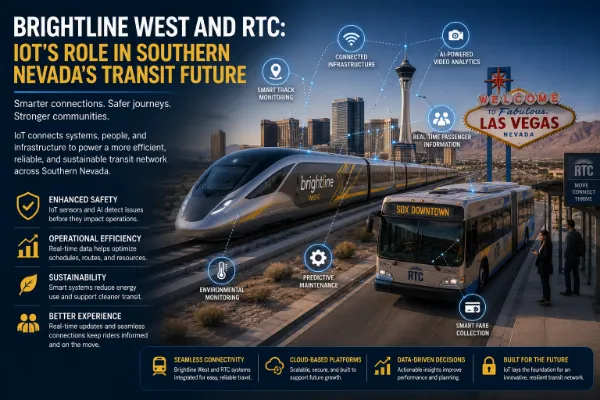
Brightline West's completion date has slipped from an originally hoped-for alignment with the 2028 Los Angeles Olympics to late 2029, but the project's fundamentals remain genuinely transformative for Southern Nevada: a 218-mile, fully electric high-speed rail line connecting Las Vegas to Southern California, running primarily in the median of Interstate 15, capable of covering the distance in roughly two hours and ten minutes at speeds exceeding 186 miles per hour less than half the typical drive time. As of 2026, the project is in active civil construction, with the parking garage at the future Las Vegas station site south of the Strip visibly taking shape, and it represents one of the more significant pieces of Southern Nevada's broader transit modernization alongside the RTC's existing traffic and transit infrastructure covered elsewhere on this site.
Brightline acquired the underlying project, originally developed by a company called XpressWest, in 2018, building on permits and planning work already underway. California approved the Las Vegas-to-Victorville route in 2020, and Caltrans entered a lease agreement allowing construction within the I-15 median. Field work began in earnest through 2024 and 2025, including preparation at the vehicle maintenance facility site in Sloan, Nevada, south of the Las Vegas Valley, and the project received a genuinely significant $3 billion federal Department of Transportation grant in December 2023 supporting the roughly $12 billion overall project cost. As of early 2026, Brightline describes the project as being in its civil construction phase preparing the I-15 corridor and surrounding land with track-laying not yet scheduled on a definite date, meaning the visible construction activity today represents infrastructure preparation rather than the rail installation itself.
The project is projected to create more than 35,000 construction jobs and roughly 1,000 permanent positions once operational, serving an estimated 11 million annual passengers. Trains will connect Las Vegas to stations in Apple Valley, Hesperia, and Rancho Cucamonga in Southern California, with the Las Vegas terminus positioned near the I-15/I-215 interchange south of the Strip a location chosen specifically to function as a modern gateway directly into the resort corridor rather than requiring a separate transit connection into the tourist core.
Running trains safely at 186-plus miles per hour depends on a fundamentally different, more intensive category of signaling and monitoring infrastructure than conventional rail service requires continuous, real-time train position and speed data feeding into automated systems managing spacing, speed enforcement, and collision avoidance with far less margin for error than slower rail service allows. This mirrors the same positive train control logic covered in this site's coverage of Caltrain's electrification in the Bay Area, but at a considerably higher speed threshold that raises the stakes on signaling accuracy and response time even further. Brightline West's all-electric, grade-separated design running primarily in a dedicated highway median rather than sharing track or crossing at-grade with other rail or vehicle traffic is itself a foundational safety decision that simplifies some of this signaling challenge compared to a system that had to share right-of-way with slower-moving traffic.
The primary Vehicle Maintenance Facility in Sloan will serve as the central hub for operations, maintenance, and control across the entire 218-mile system meaning the same condition-based, IoT-driven maintenance approach covered in this site's broader coverage of Southern Nevada infrastructure maintenance applies directly to Brightline West's rolling stock and track infrastructure. Given how much more mechanically demanding sustained high-speed operation is on rail vehicles and track compared to conventional passenger rail, continuous sensor monitoring rather than fixed-interval inspection schedules becomes less an efficiency optimization and more a fundamental safety requirement for a system operating at these speeds.
Brightline West's Las Vegas station won't function in isolation its location near the I-15/I-215 interchange puts it within the same broader corridor RTC FAST already manages intensively, covered in more detail in this site's coverage of Southern Nevada traffic management. Effective integration between Brightline's arriving passengers and local transportation options RTC Transit bus connections, rideshare and robotaxi pickup zones covered elsewhere on this site, and general Strip-corridor traffic flow will depend on exactly the kind of real-time data coordination between separate transit and traffic management systems that remains, honestly, an ongoing challenge in most U.S. metro areas rather than something automatically solved by building a new rail terminus. Southern Nevada has a real opportunity here to build that integration in from the start, given that Brightline West's station is still years from opening, rather than retrofitting coordination after the fact the way many older transit hubs have had to.
The Boring Company's Vegas Loop, covered in more detail in this site's coverage of autonomous vehicles on the Strip, represents a parallel piece of Southern Nevada's evolving transit picture an underground tunnel network already connecting the Las Vegas Convention Center to nearby resort stations, with continued expansion plans. While currently operating with human drivers rather than genuinely autonomous vehicles, the Loop addresses a fundamentally different transit need than Brightline West does: intra-Strip movement between specific resort and convention destinations, rather than intercity travel between Las Vegas and Southern California. Together, these systems point toward a Southern Nevada transit future genuinely more diverse than the region's historical near-total reliance on personal vehicles and rideshare though realizing that future depends on the kind of ongoing infrastructure investment and cross-system data integration that remains a work in progress rather than a finished achievement.
Delivering a project of Brightline West's scope requires coordinating a workforce large enough to warrant its own dedicated planning trade union announcements have specifically discussed hiring approximately 11,000 construction workers for the project's first stage alone, with teams working simultaneously from both the Nevada and California ends of the route toward an eventual meeting point at the state line. This kind of large-scale, geographically distributed construction effort depends on exactly the kind of coordinated project management and progress tracking technology covered in more depth in this site's broader coverage of megaproject jobsite monitoring a genuinely necessary capability given how many separate construction segments, contractors, and jurisdictions are involved simultaneously across a 218-mile corridor spanning two states.
Brightline West's stated goal of reducing congestion along the heavily traveled I-15 corridor connects directly to the region's broader traffic management challenge covered elsewhere on this site removing a meaningful share of Las Vegas-to-Southern-California trips from the highway entirely, rather than simply managing the same growing vehicle volume more efficiently, represents a genuinely different category of intervention than the traffic signal and sensor improvements RTC FAST manages on existing roads. As Southern Nevada's population and tourism volume continue growing, covered in more detail in this site's coverage of the region's healthcare capacity challenges facing similar growth pressure, infrastructure that removes trips from the road network entirely rather than only making existing trips flow more efficiently is likely to matter increasingly for managing the valley's continued growth over the coming decades.
Frequently asked questions
The project's completion date has been pushed to late 2029, delayed from earlier hopes of aligning with the 2028 Los Angeles Olympics, though the company reports active civil construction is underway as of 2026.
Trains will operate at speeds exceeding 186 miles per hour, covering the 218-mile route between Las Vegas and Southern California in approximately two hours and ten minutes.
The project received a $3 billion federal Department of Transportation grant in December 2023, supporting a total project cost estimated at roughly $12 billion.
Near the I-15/I-215 interchange south of the Las Vegas Strip, positioned as a modern gateway directly into the resort corridor.
Operating at speeds exceeding 186 miles per hour requires continuous, real-time train position and speed data feeding automated spacing and collision avoidance systems, with considerably less margin for error than slower conventional rail service allows.
They serve different purposes the Vegas Loop provides intra-Strip transportation between resort and convention destinations, while Brightline West provides intercity travel between Las Vegas and Southern California and together represent complementary pieces of Southern Nevada's evolving transit infrastructure.
Related articles

 Logistics & Transportation