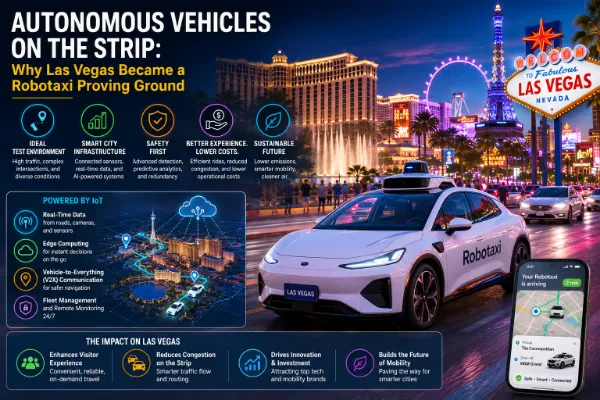
Zoox opened its purpose-built robotaxi service to the general public on the Las Vegas Strip on January 8, 2026, capping seven years of continuous testing and development in the city since the Amazon-owned company first arrived in 2019. In the months since, the service has driven nearly 2 million autonomous miles and carried more than 350,000 riders across 15 pickup and drop-off points running the length of the Strip from Fontainebleau on the north end down through Resorts World, the Las Vegas Convention Center's West Hall, AREA15, Fashion Show Mall, Wynn, the Sphere, TopGolf, Bellagio, ARIA, and New York-New York. That scale of real-world deployment, layered on top of parallel testing from Motional, the Boring Company's Vegas Loop, and Tesla, has made Las Vegas one of the most concentrated autonomous vehicle proving grounds in the country.
The Las Vegas Strip offers autonomous vehicle developers a genuinely unusual combination of conditions: a dense, geographically compact corridor with predictable, repeatable traffic patterns, an extremely high volume of pedestrian activity that stress-tests a vehicle's perception and safety systems far more intensively than a typical suburban testing route would, and critically for a company trying to reach commercial viability a customer base of tourists who are often more willing to try a novel form of transportation as part of their overall Las Vegas experience than a typical daily commuter would be in their home city. Zoox has specifically leveraged this environment, expanding its stops to include high-traffic entertainment destinations like the Sphere and TopGolf rather than only functional transit points, treating the robotaxi experience itself as part of what draws Strip visitors to try the service.
Zoox's vehicle represents a fundamentally different design approach than the more commonly recognized Waymo model rather than retrofitting a conventional car with autonomous driving hardware, Zoox built its vehicle from the ground up without a steering wheel or pedals at all, with two rows of bench seats facing each other rather than a traditional forward-facing cabin layout. Passengers can control climate and music from their seats, and the vehicle includes wireless phone charging built into the seating itself design choices that treat the absence of a human driver as an opportunity to reimagine the vehicle's interior entirely, rather than simply automating a conventional car's existing layout.
It's worth being direct about where this technology still falls short of true commercial viability, even in its most favorable testing environment. Independent field reporting has documented Zoox wait times in Las Vegas averaging around an hour during testing periods one recorded wait ran 67 minutes, a second 48 minutes a service level industry analysts have specifically characterized as commercially unviable at current fleet scale, even as the underlying vehicle technology itself performs reliably. Some local observers have also raised safety concerns based on direct observation; one Las Vegas casino industry commentator specifically flagged witnessing several near-miss situations involving Zoox vehicles outside Park MGM, underscoring that "no serious accidents yet" and "fully proven safe at scale" remain genuinely different claims, even for a service that's carried hundreds of thousands of riders without major incident.
Motional has pursued a genuinely different go-to-market approach in Las Vegas, integrating its Hyundai IONIQ 5-based autonomous vehicles directly into the existing Uber network rather than launching a standalone app and pickup point system the way Zoox has. Riders requesting an Uber in the Strip corridor may be matched with a Motional autonomous vehicle as part of the normal ride-hailing flow, with a wider service area than Zoox's dedicated pickup points, since a route that doesn't match what an available robotaxi can serve simply gets filled by a conventional Lyft or Uber vehicle instead. Motional has continued scaling its fleet toward 100 vehicles with driver-out testing ongoing in Las Vegas, even as the company's broader national robotaxi ambitions faced real setbacks its service in some other markets was suspended in 2024 amid company restructuring, making Las Vegas one of the markets where Motional has maintained continuous operational commitment despite broader strategic uncertainty elsewhere.
The Boring Company's Vegas Loop an underground tunnel system connecting the Las Vegas Convention Center to nearby resort stations represents a related but technically distinct approach to automated transportation. As of 2026, vehicles operating in the tunnel system remain human-driven Tesla vehicles rather than genuinely autonomous ones, despite public statements from Tesla CEO Elon Musk suggesting driverless operation in the tunnels was imminent. This distinction matters for understanding the actual state of autonomous technology in Las Vegas: the tunnel infrastructure itself dedicated, grade-separated routing free of pedestrian and cross-traffic complexity would theoretically make autonomous operation considerably more tractable than surface-street driving on the Strip, but the technology hasn't yet caught up to that more favorable operating environment in practice.
For Strip resort operators and retailers, covered in more detail in this site's broader coverage of Strip technology, the growing presence of multiple robotaxi services creates genuine practical considerations beyond the novelty factor dedicated pickup and drop-off zones need to be planned and coordinated across property boundaries, given how many separate autonomous vehicle operators are now active in the same corridor simultaneously, and property-level traffic management increasingly needs to account for a category of vehicle behavior extended dwell time at curbside pickup points during high-demand periods that didn't exist as a planning consideration even a few years ago. Properties that have proactively worked with these operators to establish clear pickup protocols, rather than treating robotaxi traffic as an afterthought to existing rideshare zones, tend to report smoother integration than those retrofitting accommodations after the fact.
Beyond Zoox and Motional's active operations, Tesla has secured a permit from the Nevada Department of Motor Vehicles specifically to test autonomous vehicles on Nevada public streets, though not yet to operate a commercial robotaxi service in the state, and Waymo has signaled plans for its own Las Vegas expansion. This concentration of nearly every major robotaxi developer testing or operating in the same relatively compact Strip corridor simultaneously gives Las Vegas a genuinely unique position in the industry less a single company's proving ground and more a shared, competitive testing environment where multiple fundamentally different technical and commercial approaches are being validated against the exact same real-world conditions at the same time.
None of this concentrated activity would be possible without Nevada's relatively mature autonomous vehicle regulatory framework, developed specifically to accommodate exactly this kind of multi-operator testing environment. The Nevada Department of Motor Vehicles issues the permits governing autonomous vehicle testing on public roads statewide, and the state's willingness to grant permits to multiple competing operators simultaneously rather than favoring a single exclusive partner, as some jurisdictions have is part of what's allowed Las Vegas to become a genuinely competitive, multi-company proving ground rather than a single-operator pilot market.
Frequently asked questions
Zoox began testing in Las Vegas in 2019 and opened its robotaxi service to the general public on January 8, 2026, after seven years of continuous development, having since driven nearly 2 million autonomous miles and carried more than 350,000 riders.
It combines a dense, geographically compact corridor with predictable traffic patterns, extremely high pedestrian volume that stress-tests perception systems, and a tourist customer base often more willing to try novel transportation than typical daily commuters.
Zoox built its vehicle without a steering wheel or pedals from the ground up, using two rows of bench seats facing each other rather than retrofitting a conventional car with autonomous hardware.
Not yet, according to independent field reporting. Documented wait times have averaged around an hour, a service level industry analysts have specifically characterized as commercially unviable at current fleet scale.
Not as of 2026. Vehicles operating in the underground tunnel system remain human-driven Tesla vehicles, despite public statements suggesting driverless operation was imminent.
Motional integrates its autonomous vehicles directly into the existing Uber network rather than operating a standalone app and dedicated pickup points, giving it a wider service area since unmatched routes default to a conventional human-driven vehicle.
Related articles

 Logistics & Transportation