Las Vegas has a reputation as a sprawling desert metropolis, but a 2026 UNLV Lied Center for Real Estate study actually found the opposite of what most people assume: the Las Vegas Valley ranks as the 16th most dense metro area in the country, placing it in the top 7% nationally, a result researchers attributed to geographic constraints and federal land-use policies that have limited outward expansion more than in comparable Sun Belt metros like Phoenix. The real strain on Las Vegas health systems isn't distance it's velocity. The valley's population tripled from roughly 741,000 residents in 1990 to an estimated 2.42 million by 2024, a growth rate that has consistently outpaced the region's ability to expand physical clinical capacity to match, and remote patient monitoring has become one of the more practical tools local health systems have for stretching existing capacity across a population that keeps arriving faster than new hospitals can be built.
Southern Nevada's hospital care is distributed across a genuinely varied set of systems. Valley Health System operates an integrated network of seven hospitals serving more than two million people across Southern Nevada. Sunrise Health System, part of HCA Healthcare, runs 35 locations including four full-service hospitals, four physician-based emergency rooms, four surgery centers, and 17 urgent care centers. Within that network, MountainView Hospital and Sunrise Hospital illustrate just how different two facilities under the same parent system can be: MountainView, in a suburban setting, sees a large volume of elderly and chronically ill patients transferred from skilled nursing and complex care facilities, while Sunrise Hospital, located centrally, handles the largest EMS traffic volume in the entire state of Nevada. That kind of internal variation a chronic-disease-heavy suburban population on one side of the system, an acute trauma and emergency-heavy urban population on the other shapes very different remote monitoring priorities depending on which facility and patient population a given program is designed to serve.
Clark County grew 2.1% in 2024, more than four times the national average, and Nevada's statewide population reached 3.21 million in 2025 with Clark County accounting for roughly 75% of that total. This kind of sustained, rapid growth creates a genuinely different capacity problem than distance-driven access issues common in more geographically dispersed rural health systems it's not that patients can't physically reach a hospital, it's that the absolute number of patients needing care is growing faster than physical hospital bed capacity, physician recruitment, and nursing staffing can realistically expand to match. Remote patient monitoring addresses this specific mismatch directly: extending a fixed clinical staff's effective reach across a larger patient population by concentrating in-person attention on patients whose remote data actually indicates a developing problem, rather than requiring every chronic disease patient to be seen in person on a fixed schedule regardless of how they're actually doing.
Las Vegas health systems face a genuinely unusual demand pattern that most U.S. metro areas don't: more than 40 million tourists visit annually, and that transient population generates real, continuous emergency and urgent care demand layered on top of the needs of the roughly 2.42 million permanent residents. This tourist-driven demand doesn't respond to remote monitoring the same way chronic disease management for permanent residents does a visitor experiencing a medical emergency during a convention or a Strip vacation needs immediate, in-person emergency care, not a home monitoring device shipped days later. But the indirect effect matters considerably: every bit of hospital and emergency department capacity remote monitoring programs free up by keeping stable chronic disease patients out of the emergency department is capacity that becomes available to absorb the unpredictable, tourism-driven emergency volume that Las Vegas's healthcare infrastructure has to accommodate on top of its resident population's needs.
Nevada has become a genuine growth market for senior housing and healthcare investment, with active adult, assisted living, memory care, and continuing care retirement communities all expanding rapidly, particularly in Las Vegas and secondary markets like Henderson. This demographic trend compounds the capacity pressure described above an aging population generally requires more frequent, more intensive healthcare contact than a younger population, meaning Southern Nevada's health systems face simultaneous pressure from overall population growth and a shifting age composition within that growing population, both pointing toward the same conclusion: extending clinical capacity through remote monitoring rather than relying purely on proportional physical infrastructure expansion.
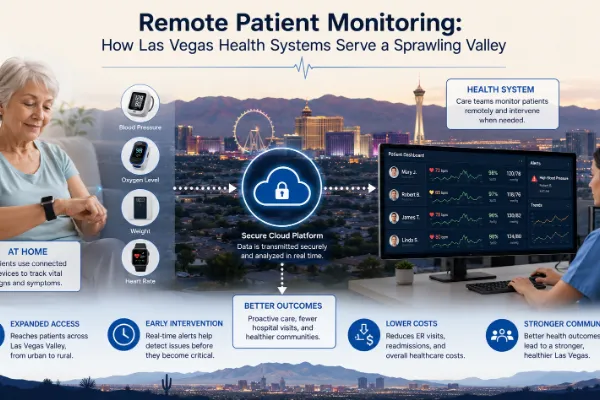
Across Las Vegas's hospital systems, the device categories doing the practical work of remote monitoring follow patterns familiar from other U.S. markets cellular-connected blood pressure cuffs and glucose monitors, weight scales and pulse oximeters for heart failure and COPD management but with particular relevance to MountainView's specific patient population of elderly, chronically ill patients transferred from skilled nursing facilities, where remote monitoring can help identify a developing complication before it necessitates a costly, disruptive hospital readmission. UMC, Southern Nevada's major public hospital system, faces this capacity challenge with the added complexity of serving a broader safety-net population, making the operational efficiency gains from remote monitoring extending limited clinical staff capacity across more patients particularly consequential for a resource-constrained public system managing the same regional growth pressure as its private counterparts.
For Las Vegas families weighing a remote monitoring program for an aging parent or a chronically ill family member, a few practical questions cut through marketing language effectively: does the specific hospital or health system have a program tailored to the patient's actual condition and care setting a MountainView-affiliated program for a patient transitioning from skilled nursing looks different than a general chronic disease program elsewhere in the valley and what happens specifically when a reading falls outside the expected range, given how much emergency department capacity across the region already absorbs unpredictable tourism-driven demand on top of resident needs. Given the valley's continued rapid growth, it's also worth asking how a program plans to scale as patient volume increases, since a monitoring program that works well at today's enrollment levels may face genuine strain as Las Vegas's population continues its historical growth trajectory.
Given how directly Las Vegas's population growth trajectory continues to outpace what physical healthcare infrastructure expansion alone can match, remote monitoring is likely to keep expanding from a supplementary program into a more central piece of how the region's health systems manage capacity generally. The honest challenge facing every Las Vegas health system covered here is the same: building clinical infrastructure fast enough to match a metro area that's added more than 1.7 million residents since 1990, without the multi-decade lead time that hospital construction and physician training typically require, makes technology-driven capacity extension less an optional efficiency improvement and more a practical necessity for keeping pace with the valley's continued growth.
As in other markets covered on this site, Las Vegas health systems investing in remote monitoring face the same national tension between genuine clinical value and reimbursement rates that often don't fully cover the technology and staffing costs involved. Medicare's remote physiologic monitoring billing codes provide a defined payment pathway, but the requirements around minimum monitoring days per month and mandated interactive patient communication add administrative overhead that shapes how aggressively any given Las Vegas system can scale a program. Given how much of Southern Nevada's population growth includes working-age relocators alongside a growing senior population, local systems increasingly need billing and program design flexible enough to serve both a Medicare-heavy chronic disease population and a younger, commercially insured population with different monitoring needs and reimbursement pathways entirely.
Frequently asked questions
Less than commonly assumed. A 2026 UNLV study found the Las Vegas Valley ranks as the 16th most dense metro area in the country, in the top 7% nationally, due to geographic and federal land-use constraints limiting outward expansion.
Rapid population growth from roughly 741,000 residents in 1990 to an estimated 2.42 million by 2024 has outpaced the region's ability to proportionally expand physical hospital capacity, physician recruitment, and nursing staffing.
More than 40 million annual visitors generate continuous, unpredictable emergency and urgent care demand layered on top of resident needs, making the hospital capacity remote monitoring frees up from resident chronic disease management indirectly valuable for absorbing tourism-driven volume.
MountainView, in a suburban setting, serves a large volume of elderly and chronically ill patients transferred from skilled nursing facilities, while Sunrise Hospital handles the largest EMS traffic volume in Nevada, reflecting genuinely different remote monitoring priorities within the same parent health system.
Valley Health System operates an integrated network of seven hospitals serving more than two million people across Southern Nevada.
Yes. Nevada has become a significant growth market for senior housing and care, particularly in Las Vegas and Henderson, compounding capacity pressure since an aging population generally requires more frequent healthcare contact than a younger one.
Related articles

 Healthcare IoT