Nurses can lose up to an hour per shift searching for mobile equipment that was in the building the entire time a statistic that holds true regardless of geography, but the specific shape of Las Vegas's hospital landscape, spanning Valley Health System's seven-hospital network, Sunrise Health System's 35-location HCA network, and the public safety-net capacity provided by UMC, creates a genuinely varied set of equipment tracking challenges depending on which facility and patient population a given hospital actually serves.
Las Vegas doesn't have a single dominant health system the way some smaller metro areas do care is distributed across Valley Health System, Sunrise Health System's HCA-owned network, and UMC's public safety-net infrastructure, each operating independently with its own procurement, asset management, and IT systems. Within Sunrise Health System alone, MountainView Hospital and Sunrise Hospital illustrate how differently equipment demand can look even within the same parent organization: MountainView's large volume of elderly patients transferred from skilled nursing facilities creates sustained demand for mobility aids, wound care equipment, and chronic-care monitoring devices, while Sunrise Hospital's status as the site of Nevada's largest EMS traffic volume creates a different equipment profile entirely trauma bay equipment, rapid-turnover diagnostic imaging access, and the kind of high-acuity gear that needs to be locatable within seconds during an active emergency department surge, not just efficiently over the course of a shift.
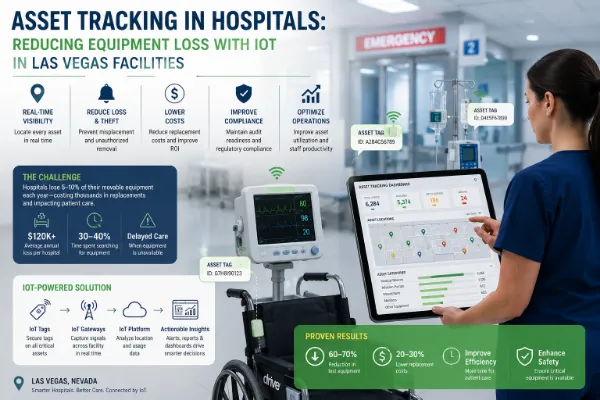
The financial stakes are well documented nationally and apply directly to Las Vegas's hospital operators: a typical 300-bed facility loses $1 million to $2 million annually to missing or underutilized assets, and real-world examples illustrate the scale of the underlying problem clearly a 380-bed hospital discovered it was carrying 1,200 IV pumps at just 30% utilization before implementing tracking technology, and after gaining real visibility into actual usage patterns, the same clinical workload only required 780 units, representing more than $1 million in capital savings from a single equipment category once the hospital understood what it already owned and where it actually was.
Real-time location systems for hospital equipment generally rely on a combination of core technologies:
- Bluetooth Low Energy (BLE) beacons attached to equipment, read by receivers positioned throughout a facility, providing room-level or zone-level location accuracy at reasonable cost the most common approach for general equipment tracking across most hospital workflows.
- Ultra-Wideband (UWB) delivers sub-meter, near bed-level accuracy, particularly relevant in the kind of high-acuity trauma and emergency environments that define Sunrise Hospital's specific patient volume, where knowing exactly which bay a piece of equipment sits in carries genuine clinical urgency during an active resuscitation.
- Active and passive RFID supports both continuous tracking and checkpoint-based visibility, useful for lower-cost inventory tracking at points like sterile processing or central supply.
- IoT condition sensors layered onto location tracking add temperature and humidity data, critical for refrigerated pharmaceutical and vaccine storage across any of the region's hospital systems.
Given how Las Vegas's hospital care is genuinely distributed across independently owned and operated systems, the realistic path to better asset visibility isn't a single, region-wide tracking platform spanning Valley Health, Sunrise Health System, and UMC simultaneously these are separate organizations with separate financial models, separate procurement relationships, and no underlying business reason to share this kind of operational data with competing systems. What's both realistic and genuinely valuable is each individual system achieving comprehensive visibility across its own multi-site footprint: Sunrise Health System coordinating tracking across its 35 locations, Valley Health System doing the same across its seven hospitals, and UMC managing its own public system independently. This mirrors the pattern seen in other multi-system metro areas covered elsewhere on this site the real return comes from solving the visibility gap within an organization's own footprint, not from an unrealistic ambition to unify tracking across organizationally and financially distinct competing health systems.
Beyond the widely cited search-time reduction of 90% or more once a system is properly implemented, the operational value compounds across categories directly relevant to Las Vegas's specific hospital mix. Preventive maintenance compliance becomes meaningfully easier when equipment location is always known, closing a real regulatory risk gap that matters during accreditation surveys regardless of which specific system is under review. For UMC specifically, operating as the region's major public safety-net provider, right-sizing capital equipment purchases based on real utilization data the same logic behind the 1,200-to-780 IV pump example carries outsized value given how directly every dollar of avoided unnecessary capital spending affects a resource-constrained public system's ability to serve its broader mission.
A genuinely Las Vegas-specific wrinkle worth noting: hospital systems here manage equipment demand shaped partly by the region's more than 40 million annual visitors, covered in more depth in this site's coverage of remote patient monitoring locally. Emergency and trauma equipment utilization at facilities like Sunrise Hospital reflects not just resident population needs but the additional, less predictable demand generated by tourist medical emergencies a genuinely different capacity planning problem than a comparably sized hospital system serving a purely resident population would face, and one where accurate, real-time equipment utilization data matters more given how much less predictable tourism-driven demand patterns are compared to the more stable, forecastable demand from a stationary resident population.
The internal argument for asset tracking investment looks different depending on which type of Las Vegas health system is making the case. For Sunrise Health System's HCA-owned, for-profit model, the pitch tends to center on operational efficiency and standardized metrics the parent company already tracks across its national portfolio of facilities. For Valley Health System's integrated network, asset tracking data can support coordination across its seven hospitals, helping identify whether equipment could be more efficiently shared or repositioned across facilities rather than each hospital independently over-purchasing to cover its own worst-case demand scenario. For UMC's public, budget-constrained environment, the case is most directly financial: pulling a year of equipment rental invoices and identifying how many of those rentals covered for devices the system already owned but couldn't locate turns an abstract efficiency argument into a concrete number a public hospital board can act on directly.
Given Southern Nevada's continued rapid population growth, covered in more detail in this site's coverage of remote patient monitoring locally, Las Vegas hospital systems implementing asset tracking should plan for capacity growth from the outset rather than sizing a system purely around current patient volume. A tracking platform configured for today's bed count and equipment inventory may need meaningful expansion within just a few years given how quickly the region's healthcare demand has historically grown, making scalability a genuine evaluation criterion alongside the more immediate search-time and cost-reduction benefits any vendor pitch will emphasize.
Frequently asked questions
Care is distributed across independently operated systems Valley Health System, Sunrise Health System, and UMC each with separate procurement and IT infrastructure, and even within a single system, facilities like MountainView and Sunrise Hospital have genuinely different equipment demand profiles.
Generally not in practice. Different health systems have separate financial models and no underlying business reason to share this operational data; realistic value comes from each system achieving unified visibility within its own multi-site footprint.
As the site of Nevada's largest EMS traffic volume, Sunrise Hospital benefits particularly from Ultra-Wideband tracking's sub-meter accuracy, given how much clinical urgency attaches to locating equipment quickly during active trauma and emergency situations.
As Southern Nevada's major public safety-net hospital system, every dollar of avoided unnecessary capital spending carries a more direct and consequential opportunity cost than it would for a better-resourced private system.
Yes. More than 40 million annual visitors generate additional, less predictable emergency and trauma equipment demand on top of resident population needs, particularly at high-EMS-volume facilities, making accurate real-time utilization data especially valuable.
A documented example shows a hospital reducing its IV pump fleet from 1,200 to 780 units after gaining real utilization visibility, representing more than $1 million in capital savings from a single equipment category.
Related articles

 Healthcare IoT