University Medical Center sits a few blocks west of downtown and the Strip, and for most of its history it carried a distinction no hospital administrator wants: Nevada's only Level I trauma center, meaning the most severely injured patients across the entire state and parts of Arizona, Utah, and Southern California had exactly one facility built to receive them. That fact became national news on October 1, 2017, when a mass shooting sent more than five hundred injured people to Las Vegas hospitals in a matter of hours, with UMC and Sunrise Hospital absorbing the bulk of the trauma load. The response exposed real capacity limits, and it also set in motion a slower, less publicized shift in how Southern Nevada's hospital systems think about monitoring, triage, and data during both mass casualty events and ordinary daily operations.
UMC has spent the years since investing heavily in modernization, culminating in a renovation effort that hospital leadership has explicitly framed around cutting-edge technology and trauma care rather than cosmetic upgrades alone. That investment mirrors a broader pattern seen across large trauma systems nationally: once a hospital builds out the monitoring and triage infrastructure needed to handle a genuine mass casualty surge, much of that same infrastructure, connected vital sign monitors, real time bed and resource tracking, wireless telemetry that follows a patient rather than staying tied to a single room, becomes the backbone of everyday operations rather than something that sits dormant until the next emergency. Sunrise Hospital's later designation as a second Level I trauma center in the Las Vegas Valley, a contested decision given its own history treating more than 250 patients during the 2017 shooting, reflects the same underlying logic: a metro area this size increasingly needs redundant, technology-enabled trauma capacity rather than a single facility carrying the full load.
Separate from trauma care, Las Vegas has an unusual structural advantage in healthcare IoT adoption that has nothing to do with local hospital budgets: it hosts the events where much of this technology launches. CES, held every January in Las Vegas, has become a genuine venue for connected health announcements rather than a novelty sideshow. At CES 2026, connected health data platform Validic used the show to highlight how its AI-enabled system converts continuous device and wearable data into clinically relevant summaries for care teams, technology that already supports more than 500,000 patients across programs covering hypertension, diabetes, and heart failure management. The company built its platform to integrate natively with major electronic health record systems, meaning the underlying data plumbing is designed to slot into existing hospital IT rather than requiring a separate parallel system.
The National Telehealth and Virtual Care Summit likewise convenes at Caesars Palace annually, drawing hospital executives, clinicians, and policymakers specifically to discuss remote patient monitoring, virtual care delivery, and digital health equity. For local health systems, this creates a genuine, if underused, advantage: technology vendors debut and refine remote monitoring platforms in the same city where Southern Nevada's hospital administrators work, well before those platforms reach broader market adoption elsewhere. A hospital IT director in Cleveland or Atlanta has to travel to see these systems demonstrated; a Las Vegas health system can send staff across town for a few hours and walk the show floor during a normal workweek.
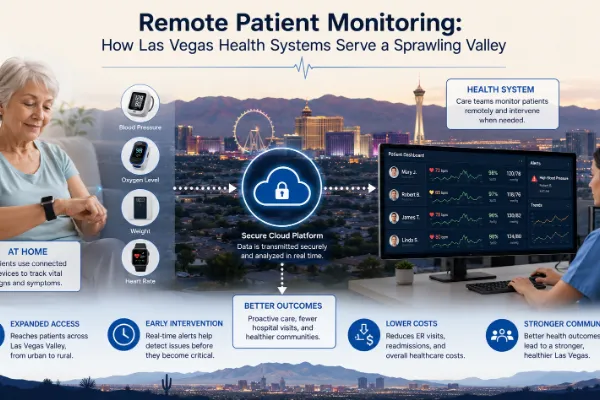
Academic research on wearable-based remote monitoring gives a useful picture of what these systems are built to catch. A 2025 proof-of-concept study on multi-sensor wearables described a wrist-worn device tracking heart rate, body temperature, blood oxygen saturation, and fall detection through an accelerometer, streaming data via Bluetooth to a smartphone app that triggers alerts for vital sign deviations or falls. The explicit motivation behind that kind of design is reducing emergency department strain, catching a deteriorating chronic condition or a fall risk before it turns into an ER visit rather than after. That is precisely the same logic driving hospital-at-home models more broadly: continuous monitoring lets lower-acuity patients recover outside a hospital bed while still giving care teams an early warning if something changes.
The clinical research literature also points to a practical lesson worth internalizing before launching a program locally: successful remote monitoring rollouts tend to start narrow. Mayo Clinic's own nurse-led remote monitoring program began with focused pilots for specific conditions, cirrhosis, acute kidney injury, post-pancreatectomy, and post-gastroenterology procedure recovery, before scaling into a broader framework supporting close to twenty-two thousand patients across seventeen distinct programs. That staged approach, proving out a hybrid nursing model and the underlying technology on a manageable patient population before expanding, is a far more realistic template for a Las Vegas health system than attempting a valley-wide rollout on day one.
| Monitoring Approach | What It Tracks | Primary Value |
|---|
| Wrist-worn multi-sensor wearables | Heart rate, temperature, blood oxygen, fall detection | Early alerting for vital sign deviations and falls in at-risk patients |
| In-hospital wireless telemetry | Continuous vital signs across a mobile patient | Removes the need to keep a patient tethered to a single monitoring station |
| AI-enabled data platforms | Aggregated device and wearable data synthesized into clinical summaries | Reduces alert fatigue by surfacing only clinically relevant trends to care teams |
Remote monitoring is not just a clinical nicety, it has a direct cost story that matters to hospital finance departments as much as to care teams. Preventable readmissions are expensive under value-based care contracts, and catching a heart failure patient's early fluid retention through a connected weight scale or a diabetes patient's glucose trend through a continuous monitor, before either turns into an emergency department visit, is measurably cheaper than the alternative. For a health system like Valley Health System, which operates seven hospitals across Southern Nevada serving more than two million people, that arithmetic scales meaningfully across a large enough patient population. The challenge, and the opportunity, is building monitoring programs specifically around the conditions where the avoided-cost math is clearest, rather than deploying monitoring technology broadly and hoping for a return.
- Treat EHR integration as a non-negotiable requirement when evaluating any remote monitoring platform, since a system generating alerts outside a clinician's existing workflow is far less likely to get consistently reviewed.
- Prioritize monitoring programs for the conditions with the clearest readmission cost, such as heart failure and diabetes management, where the evidence base for remote monitoring reducing hospitalizations is strongest.
- Use CES and the Telehealth Summit as evaluation opportunities, not just conference attendance, since vendors demonstrating platforms in Las Vegas are frequently seeking early hospital system partners for pilot programs.
- Plan staffing around alert triage from the start, since a monitoring program that generates more alerts than a care team can reasonably review creates alert fatigue rather than better outcomes.
Device security remains a serious concern industry-wide, with medical device cyberattacks reportedly increasing well over one hundred percent year over year, a risk profile that matters enormously for connected monitoring equipment running continuously in patient rooms and homes. Alert fatigue is a related, more mundane problem: a monitoring system that floods a nursing station with notifications for minor fluctuations trains staff to deprioritize alerts generally, which defeats the purpose of continuous monitoring. Reimbursement structures for remote patient monitoring also remain uneven, and programs built around Medicare's evolving value-based models need administrative staff who understand exactly what documentation and monitoring thresholds qualify for reimbursement, a non-clinical burden that can quietly determine whether a well-designed monitoring program is financially sustainable.
Expect continued growth in AI-synthesized monitoring platforms that reduce raw data into actionable clinical summaries, following the model Validic and similar companies showcased at CES 2026, since raw sensor data alone has limited value without a layer that filters it for clinical relevance. Southern Nevada's trauma network is also likely to keep investing in connected triage and resource tracking infrastructure, building on lessons from 2017 and the ongoing UMC modernization, both to prepare for future mass casualty scenarios and to improve everyday patient flow across a valley whose population continues to grow faster than most other major U.S. metros. Partnerships between local health systems and UNLV's School of Medicine, which has affiliated with Sunrise Hospital since 2017, are a plausible channel for testing new monitoring approaches in a teaching hospital setting before wider clinical rollout, giving Las Vegas a research pathway that pairs naturally with its existing role as a health tech conference destination. Businesses and health systems exploring monitoring technology partners can browse the Las Vegas IoT companies directory for regional providers, and ongoing coverage of related developments is tracked in the Healthcare IoT section.
Frequently asked questions
Las Vegas hosts major events like CES and the National Telehealth and Virtual Care Summit, where connected health platforms are announced and demonstrated. This gives local hospital administrators early, in-person access to remote monitoring technology before it reaches broader market adoption.
More than five hundred injured people arrived at Las Vegas hospitals within hours, with University Medical Center, Nevada's only Level I trauma center at the time, and Sunrise Hospital absorbing most of the trauma load, exposing real limits in the region's emergency capacity.
A 2025 proof-of-concept multi-sensor wearable tracked heart rate, body temperature, blood oxygen saturation, and fall detection through an accelerometer, streaming data via Bluetooth to a smartphone app that triggers alerts for vital sign deviations or falls.
A monitoring platform that generates alerts outside a clinician's existing electronic health record workflow is far less likely to be consistently reviewed, so integrating monitoring data directly into systems clinicians already use is critical to a program's effectiveness.
Alert fatigue occurs when a monitoring system generates more notifications than a care team can reasonably review, training staff to deprioritize alerts generally. This undermines the entire purpose of continuous monitoring and needs to be addressed through careful threshold tuning.
Sunrise Hospital, which treated more than 250 patients during the 2017 shooting, was later designated a second Level I trauma center in the Las Vegas Valley, reflecting a broader push toward redundant, technology-enabled trauma capacity rather than relying on a single facility.
Related articles

 Healthcare IoT