Southern Nevada's manufacturing base has quietly diversified well beyond the gaming equipment production covered in more depth elsewhere on this site. Nevada added roughly 1,000 manufacturing jobs between February 2025 and February 2026, part of a broader state trend that added 34,000 jobs across all sectors over the same period, and Foreign Trade Zone 89 is set to double its number of manufacturing operators from seven to fourteen during 2026 alone. Clark County now counts more than 1,000 manufacturing facilities employing over 20,000 workers, with the state projecting an 8% increase in manufacturing employment over the coming seven years. This growth is bringing a genuinely wider range of production processes to the region, and with it, a wider range of real-time quality control challenges than the gaming-equipment-dominated manufacturing narrative most people associate with Nevada.
The recent wave of new and expanding operations illustrates the sector's genuine diversification. Haas Automation, a major CNC machine tool manufacturer, is establishing a new Henderson facility directly across from the College of Southern Nevada's Debra March Center for Excellence itself launched specifically to train the workforce this kind of advanced manufacturing growth requires. Nuance Medical has expanded its Southern Nevada footprint to support growth in the region's medical products manufacturing sector. Taylor Print & Visual Impressions is investing in advanced printing, automation, and manufacturing technology at its North Las Vegas operation. Forge Industries is establishing its first U.S. production facility in North Las Vegas, converting non-recyclable waste into alternative fuels. Alongside longer-established employers like Sofidel America and Saratoga Foods, this represents a genuinely broad manufacturing base spanning precision machine tools, medical devices, advanced printing, and food and paper production each with distinct quality control requirements that don't map cleanly onto a single, generic "factory floor" quality control template.
A CNC machine tool manufacturer like Haas Automation faces quality control demands centered on dimensional precision and tolerance verification the kind of automated optical and coordinate measurement inspection that catches micron-level deviations in machined parts before they leave the facility. A medical products manufacturer like Nuance Medical operates under FDA quality system requirements considerably more stringent than general industrial manufacturing, requiring the kind of continuous, auditable inspection documentation covered in more depth in this site's broader coverage of medical device manufacturing quality control. A food production facility like Saratoga Foods faces an entirely different quality control regime centered on food safety, contamination detection, and cold chain integrity rather than dimensional precision at all. This means Southern Nevada's growing manufacturing sector genuinely can't be served by a single, one-size-fits-all IoT quality control platform the region's diversification is creating real demand for quality control technology vendors and integrators with genuine cross-sector flexibility.
Foreign Trade Zone 89's expansion from seven to fourteen manufacturing operators in 2026 adds a distinct compliance dimension to quality control for companies operating within its boundaries. FTZ status lets qualifying manufacturers defer, reduce, or eliminate certain customs duties on imported components used in domestic production, but that benefit comes with real documentation requirements components entering and materials leaving an FTZ facility need accurate, auditable tracking that connects directly to the same production and quality data a manufacturer's internal quality control system already generates. IoT-based inventory and production tracking systems that can feed both internal quality management and FTZ customs documentation from the same underlying data stream offer a genuine efficiency advantage for manufacturers operating within Zone 89's expanding operator base, avoiding the duplicated effort of maintaining separate systems for quality assurance and customs compliance.
Clark County's own economic development materials specifically emphasize the region's position along three major highway corridors providing low-cost access to higher-cost West Coast markets like California, alongside Harry Reid International Airport's capacity to move goods to regional, national, and international markets, covered in more detail in this site's coverage of the airport's own cargo operations. For manufacturers serving West Coast markets from a Southern Nevada production base, the ability to catch a quality defect before a shipment leaves the facility carries outsized value precisely because the whole logistics advantage of manufacturing here lower costs than California with reasonable proximity to it depends on products actually reaching customers correctly the first time, without the added cost and delay of a return shipment across state lines to address a quality issue that better in-line inspection would have caught before the product ever left Nevada.
Southern Nevada manufacturers evaluating quality control technology vendors should specifically ask about cross-sector implementation experience given the region's genuine diversity a vendor whose primary track record is with automotive or general consumer electronics manufacturing may not translate cleanly to a food production or medical device manufacturing environment with fundamentally different regulatory and contamination-control requirements. It's also worth asking directly whether a prospective vendor has existing experience with Foreign Trade Zone documentation requirements specifically, since integrating quality control data with customs compliance tracking is a genuinely specialized capability that not every industrial IoT vendor has built into their platform, even ones with otherwise strong general manufacturing quality control credentials.
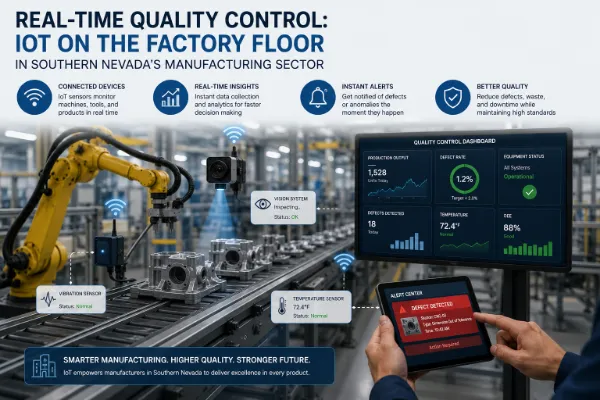
College of Southern Nevada's manufacturing program expansion, anchored by the Debra March Center for Excellence, reflects a genuine recognition that IoT-driven quality control technology only delivers value when paired with a workforce capable of interpreting and acting on the data it generates. A vision inspection system or automated measurement platform is only as useful as the technicians and engineers who calibrate it, investigate the anomalies it flags, and translate its output into actual process improvements making the region's investment in manufacturing workforce training a genuinely necessary complement to the physical technology investment happening alongside it, not a separate, disconnected economic development initiative.
For a Southern Nevada manufacturer evaluating IoT quality control investment for the first time, a sensible approach starts with identifying the single production step responsible for the most customer-facing quality complaints or the most costly downstream rework, rather than attempting comprehensive inspection coverage across an entire production line immediately. Whether that's a specific machining operation prone to tolerance drift, a packaging step where contamination risk concentrates, or a print run stage where registration errors most commonly occur, starting narrow and demonstrating measurable improvement before expanding tends to build the kind of internal confidence and budget support that a broad, unproven initial deployment struggles to generate, particularly for smaller and mid-size operators competing against better-resourced new entrants to the region.
Frequently asked questions
Nevada added roughly 1,000 manufacturing jobs between February 2025 and February 2026, and Clark County now hosts more than 1,000 manufacturing facilities employing over 20,000 workers, with an 8% employment increase projected over the next seven years.
Precision CNC machine tools (Haas Automation), medical products (Nuance Medical), advanced printing and automation (Taylor Print & Visual Impressions), alternative fuel production (Forge Industries), and established food and paper manufacturing (Sofidel America, Saratoga Foods) all represent significant, growing segments.
FTZ operators need accurate, auditable tracking of components and materials for customs compliance, and IoT systems that feed both internal quality management and FTZ documentation from the same data stream avoid duplicated tracking effort.
The region's diversifying manufacturing base spans precision machining, medical devices, food production, and advanced printing, each with fundamentally different quality control requirements dimensional precision, FDA compliance, food safety, and print quality respectively.
Given the region's cost advantage serving West Coast markets while remaining close to California, catching defects before shipment carries outsized value, since the whole logistics advantage depends on products reaching customers correctly without costly return shipments.
Programs like College of Southern Nevada's Debra March Center for Excellence train the technicians and engineers needed to calibrate and act on quality control system data, since the technology only delivers value when paired with staff capable of interpreting its output.
Related articles

 Manufacturing IoT