Nevada operates its own state OSHA program under NRS 618, and its heat illness prevention regulation applies to something a lot of manufacturing and warehouse operators don't expect: indoor workers, not just the outdoor construction and landscaping crews most people associate with heat regulation. As one Nevada workplace injury attorney put it plainly in June 2026 guidance, a warehouse with a broken HVAC system, a delivery vehicle with a failed air conditioner, or a hotel kitchen without adequate ventilation could all fall within the rule's reach employers don't get a free pass simply because a climate-control system was present at some point. For Las Vegas-area manufacturing and warehouse facilities, this makes IoT-based temperature and heat index monitoring considerably more than a comfort consideration; it's a genuine compliance requirement with real documentation obligations attached.
Nevada's heat illness prevention regulation, adopted under NRS 618 and enforced by Nevada OSHA under the state's federally approved State Plan, requires employers with 10 or more workers to conduct a formal Job Hazard Analysis whenever a majority of their workforce is exposed to excessive heat for at least 30 minutes out of any 60-minute work period. The regulation applies to both indoor and outdoor workers, with specific provisions addressing indoor workplaces in climate-controlled environments meaning a manufacturing facility or warehouse can't assume that having air conditioning installed automatically satisfies the rule if that system isn't actually maintaining safe conditions in practice. Employers must document environmental risk factors including temperature and humidity, physical job demands like heavy lifting and PPE use, and assess risk levels using Wet Bulb Globe Temperature and related heat stress indices a more technically specific risk assessment framework than a simple thermometer reading provides.
Covered employers must maintain a written heat illness prevention plan addressing five core elements: accessible cool drinking water maintained at a temperature workers will actually drink, paid recovery breaks triggered when conditions exceed defined thresholds commonly 95°F as a heightened-requirement trigger point heat illness training for every worker and supervisor before exposure, documented emergency response procedures, and a monitoring plan for workers, including specific provisions for employees working alone at remote locations. This monitoring requirement is where IoT technology becomes directly relevant to actual compliance, not just general workplace comfort: Nevada OSHA's own guidance specifies that remote or isolated workers need documented check-in protocols, commonly every 30 to 60 minutes, with escalation to emergency response procedures if a worker fails to respond after a second contact attempt.
Given the rule's emphasis on documented, ongoing risk assessment rather than a one-time facility evaluation, continuous IoT-based temperature and heat index monitoring offers a genuinely more defensible compliance posture than periodic manual checks. A facility relying on someone walking the floor with a thermometer once or twice a shift risks missing exactly the kind of transient conditions an HVAC system momentarily struggling during a particularly hot afternoon, a specific zone near loading dock doors running warmer than the rest of a warehouse that continuous sensor monitoring catches automatically and, critically, generates the kind of timestamped documentation record that demonstrates ongoing compliance if a Nevada OSHA inspection or an injury claim investigation ever requires it. Given that Nevada OSHA updated its heat illness guidance as recently as May and June 2026, with active enforcement specifically noted, this documentation trail carries real, current regulatory weight, not a theoretical future risk.
It's worth understanding how Nevada's approach fits into the broader national regulatory picture, since this shapes how much weight the state's own rule actually carries. Federal OSHA's National Emphasis Program on heat-related hazards expired April 8, 2026, with no clear indication the current federal administration intends to extend or replace it, and OSHA's proposed permanent federal heat illness standard remains stalled with no target finalization date. This means Nevada's own state-specific standard, rather than a comparable federal requirement, is now the primary enforceable heat illness regulation Las Vegas-area employers actually operate under a genuinely different situation than it might have been just a couple of years ago, when federal emphasis program enforcement provided an additional layer of regulatory pressure alongside state rules. Nevada OSHA has continued actively updating and enforcing its own standard even as federal heat enforcement activity has lapsed, making state-specific compliance the primary, not secondary, consideration for Southern Nevada manufacturers and warehouse operators.
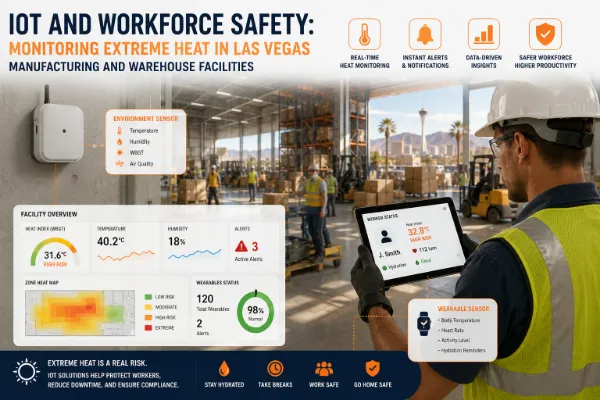
- Zone-level temperature and humidity sensors distributed across a facility rather than relying on a single central reading, since heat distribution varies meaningfully across a large manufacturing floor or warehouse areas near loading docks, ovens, or poorly ventilated corners routinely run hotter than a facility's average.
- Automated threshold alerting tied specifically to the regulation's trigger points, notifying supervisors when conditions approach the 95°F heightened-requirement threshold rather than requiring someone to notice discomfort and manually check conditions.
- Continuous, timestamped data logging generating the documented record Nevada's Job Hazard Analysis and written plan requirements expect, automatically rather than through manual logging that's easy to fall behind on during a busy shift.
- Wearable-based monitoring for isolated or remote-working employees, supporting the specific check-in and escalation protocol Nevada OSHA guidance describes for workers without direct, continuous supervisor contact.
A common concern among Southern Nevada facility safety managers evaluating this technology is alert fatigue a monitoring system generating constant low-priority notifications trains staff to deprioritize alerts generally, undermining the entire point of continuous monitoring. The more effective implementations tier alerts by actual severity and required response, distinguishing a routine "approaching threshold, monitor" notification from a "exceeded threshold, immediate action required" alert that triggers the specific paid recovery break and emergency response protocols Nevada's written plan requirement expects. This tiering work takes more upfront configuration than accepting a vendor's default alert settings, but it's what determines whether a monitoring system actually changes floor behavior in a way that satisfies Nevada OSHA's documented, ongoing risk mitigation expectation, or just becomes background noise a safety team learns to tune out.
For a Southern Nevada manufacturing or warehouse facility weighing this investment, the clearest framing pairs regulatory compliance with the genuine operational cost of heat-related productivity loss and turnover a workforce experiencing uncomfortable or unsafe heat conditions doesn't just carry injury and compliance risk, it experiences higher turnover and lower productivity, both genuinely consequential in a labor market already tight enough to affect the broader manufacturing growth covered in this site's coverage of Southern Nevada's downtime-reduction challenges. Given that Nevada OSHA has demonstrated continued, active enforcement of this standard even as federal heat regulation has stalled, treating continuous monitoring as compliance infrastructure not just an employee comfort perk is the more accurate and more defensible framing for any internal investment case.
Frequently asked questions
Yes. The regulation covers both indoor and outdoor workers, and a facility with an inadequate or malfunctioning HVAC system can fall within the rule's reach even if climate control equipment is technically present.
Employers with 10 or more workers must conduct a formal Job Hazard Analysis when a majority of their workforce is exposed to excessive heat for at least 30 minutes out of any 60-minute work period.
Conditions exceeding 95°F commonly trigger heightened requirements, including mandatory paid recovery breaks, though the regulation's risk assessment also considers humidity and Wet Bulb Globe Temperature rather than relying solely on a single temperature reading.
Federal OSHA's National Emphasis Program on heat-related hazards expired April 8, 2026 with no clear replacement plan, making Nevada's own state-specific heat illness standard the primary enforceable regulation for Southern Nevada employers.
Continuous sensor monitoring generates the timestamped documentation record the regulation's Job Hazard Analysis and monitoring plan requirements expect, more reliably than periodic manual temperature checks that can miss transient unsafe conditions.
Yes. Nevada OSHA guidance specifies documented check-in protocols for isolated workers, commonly every 30 to 60 minutes, with escalation to emergency response procedures if a worker fails to respond after a second contact attempt.
Related articles

 Manufacturing IoT