Las Vegas is, quietly, one of the more unusual manufacturing towns in America, because the product rolling off its production lines is itself a connected industrial device. Aristocrat Gaming opened a new manufacturing facility in Henderson in August 2024, expanding from eight production lines to twelve and doubling its loading dock count to twenty-two, to build the slot machines that carry franchises like Buffalo, Dollar Storm, Dragon Link, and Lightning Link onto casino floors around the world. A few miles away, International Game Technology consolidated three separate Las Vegas-area manufacturing operations into a single campus built specifically to withstand desert heat, with forty-five-foot insulated concrete tilt-up warehouse walls holding internal temperatures steady regardless of what the Mojave is doing outside. Between them, these two companies represent a genuine, if unusual, manufacturing IoT case study: an industry that both builds connected devices and immediately deploys them at scale in its own backyard.
A modern slot machine leaving an Aristocrat or IGT production line is not a standalone mechanical device the way it was decades ago. It ships as a networked endpoint designed to connect directly into a casino's management platform, the same category of system covered in our look at cashless retail IoT on the Strip, reporting meter data, game performance, and diagnostic status back to centralized software like Konami's Synkros or IGT's own ADVANTAGE platform in real time. That means the manufacturing process for these machines is not simply assembling a cabinet, screen, and payment mechanism, it is building and validating a connected industrial device that needs to function reliably as a networked node from the moment it is unboxed on a casino floor, with essentially zero tolerance for the kind of connectivity bugs a consumer electronics company might patch after a product launch.
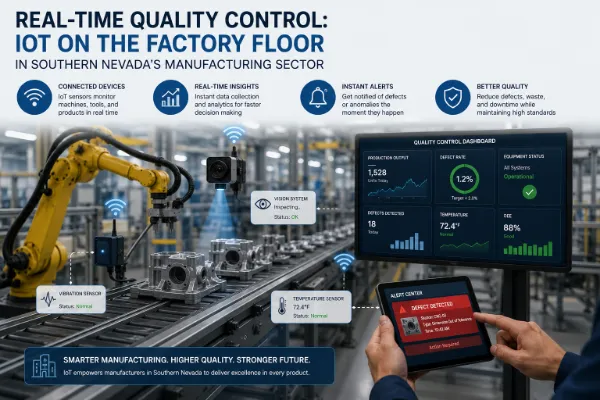
That requirement shapes the manufacturing process itself. Quality control on a production line building networked gaming devices has to verify not just mechanical assembly and electrical safety, but also network connectivity, firmware integrity, and compliance with the specific technical standards state gaming regulators require before a machine can legally operate on a casino floor. A single firmware or connectivity defect shipped across a production run has consequences far beyond a typical consumer product recall, since gaming regulators in multiple jurisdictions would need to be involved in any correction affecting devices that handle real money transactions.
IGT's Las Vegas manufacturing campus solves an environmental problem most manufacturers never have to think about: keeping a large warehouse floor at stable temperatures through a Nevada summer without runaway energy costs. The forty-five-foot insulated concrete tilt-up wall panels used in its construction are a passive engineering solution, retaining internal temperature stability largely through material choice and building geometry rather than active climate control alone, similar in spirit to the passive thermal mass strategy discussed in our coverage of Switch's data center cooling systems. For a manufacturing facility running precision electronics assembly, maintaining consistent internal conditions matters for both worker comfort and the sensitive calibration and testing equipment used to validate finished gaming devices before shipment.
Aristocrat's Henderson expansion reflects a different but related pressure: raw production throughput. Doubling dock doors and expanding from eight to twelve production lines is fundamentally a logistics and materials-flow problem, one that at this scale typically depends on real time production tracking to coordinate component deliveries against line output, rather than the periodic manual counts that might suffice at a smaller shop. A facility with 100,000 square feet of storage and a dozen active lines needs continuous visibility into exactly where each subassembly and finished unit sits at any given moment to actually hit the increased throughput the expansion was built to deliver.
| Facility | Key Manufacturing Detail | Relevant Constraint |
|---|
| Aristocrat Gaming, Henderson | 12 production lines, 22 dock doors, 100,000 sq ft storage | Coordinating materials flow and throughput across an expanded facility |
| IGT, Las Vegas | Consolidated campus with insulated tilt-up wall construction | Maintaining stable conditions for precision assembly in desert heat |
| Finished product (slot machines) | Networked endpoints reporting to casino management platforms | Zero-tolerance requirement for connectivity and regulatory compliance at shipment |
Most economic development conversations about Las Vegas focus on hospitality, entertainment, and increasingly data centers and logistics, and gaming equipment manufacturing rarely gets mentioned in the same breath despite representing genuine, sustained industrial employment in the region. That omission is understandable given how thoroughly the industry's public identity is tied to casino floors rather than factory floors, but the production side of the business is not small. Between Aristocrat's expanded Henderson facility and IGT's consolidated Las Vegas campus, the two companies alone represent a substantial concentration of precision electronics manufacturing capacity in a metro area better known for building resorts than building the machines that go inside them. That concentration also creates a distinctive regional talent pipeline: technicians and engineers trained to validate networked gaming hardware in Las Vegas are developing a skill set directly transferable to other categories of connected industrial device manufacturing, a workforce asset the broader region has not yet fully leveraged beyond the gaming sector itself.
- Treat network validation as a core quality control step, not a final add-on test, particularly for any product shipping as a connected endpoint into a regulated environment where post-shipment fixes are far more costly than catching an issue on the line.
- Match facility climate engineering to the sensitivity of what is being built, since passive design solutions like insulated tilt-up construction can reduce ongoing energy costs for precision assembly work without requiring constant mechanical climate control.
- Invest in real time production tracking before scaling line count, since adding production lines without corresponding visibility into materials flow tends to shift a bottleneck rather than eliminate it.
- Build regulatory compliance checkpoints directly into the manufacturing workflow for any product requiring jurisdiction-specific certification, rather than treating compliance as a separate process layered on after production.
Regulatory complexity is the most distinctive challenge for gaming equipment manufacturers specifically, since a single product line often needs to meet different technical and connectivity standards across the various state and international gaming jurisdictions where it will be deployed, multiplying the validation burden well beyond what a typical consumer electronics manufacturer faces. Each jurisdiction can require its own certification testing cycle before a machine is legally permitted to operate, meaning a single hardware or firmware revision can trigger a cascade of re-certification work across multiple states and countries simultaneously rather than a single unified approval process. Supply chain coordination for a facility running a dozen simultaneous production lines requires materials tracking sophisticated enough to prevent any single line from stalling the others, a genuine operational challenge as facilities scale up throughput. Workforce specialization is a related constraint, since technicians validating both electrical assembly and network connectivity on a gaming device production line need a broader skill set than either a pure electronics assembler or a pure IT technician would typically carry individually. Finally, desert climate considerations extend beyond the building envelope alone, since shipping and receiving docks handling components and finished units face the same extreme heat exposure discussed in our coverage of construction and logistics elsewhere on this site, requiring their own environmental planning.
Expect continued consolidation and expansion among the region's gaming equipment manufacturers as the industry works through recent merger activity, including IGT's return to Las Vegas following its Everi merger and acquisition by Apollo Global Management, moves likely to concentrate more manufacturing capacity and production line investment locally rather than dispersing it. As gaming devices themselves grow more sophisticated, incorporating deeper data analytics and player tracking capability demanded by casino operators, the manufacturing validation process is likely to grow correspondingly more complex, pushing manufacturers toward more automated, sensor-driven quality control on the line itself rather than relying primarily on manual inspection, mirroring the same shift toward continuous, data-driven monitoring already underway across the region's data centers, construction sites, and utility networks covered elsewhere on this site. Businesses evaluating manufacturing technology partners can browse the Las Vegas IoT companies directory, and ongoing coverage is tracked in the Manufacturing IoT section. It is a reminder that a city built around games of chance runs on remarkably little chance at all when it comes to actually building the machines those games depend on.
Frequently asked questions
Aristocrat Gaming opened a manufacturing facility in Henderson in August 2024 with twelve production lines, up from eight at its previous location, twenty-two loading docks, and 100,000 square feet of storage, producing slot machine franchises including Buffalo, Dollar Storm, and Lightning Link.
Modern slot machines ship as networked endpoints designed to connect directly into casino management platforms like Konami's Synkros or IGT's ADVANTAGE system, continuously reporting meter data, game performance, and diagnostic status rather than functioning as standalone mechanical devices.
IGT's consolidated Las Vegas campus uses forty-five-foot insulated concrete tilt-up wall panels to maintain stable internal temperatures for precision electronics assembly, a passive engineering approach that reduces reliance on continuous mechanical climate control.
Quality control must verify network connectivity, firmware integrity, and compliance with jurisdiction-specific gaming regulations in addition to standard mechanical and electrical checks, since these devices handle real money transactions and cannot be corrected as easily as typical consumer products after shipment.
Materials flow coordination is the central challenge, since adding production lines and dock capacity without corresponding real time production tracking tends to shift a bottleneck elsewhere rather than actually increasing usable throughput.
IGT's return to Las Vegas following its Everi merger and acquisition by Apollo Global Management is likely to concentrate more manufacturing capacity and production line investment in the region rather than dispersing it elsewhere.
Related articles


 Manufacturing IoT