"The whole world thinks Vegas can't grow food," Rachel Wenman, vice president of Urban Seed, told reporters as her company broke ground on its first Las Vegas farm a cluster of high-tech greenhouses planned to eventually span six structures at 6,500 square feet each, growing 25 different crops from bell peppers to alpine strawberries in the middle of the city. "We really feel that if you can grow food in Las Vegas, then you can grow food anywhere." That defiant framing captures something genuinely notable about the Las Vegas Valley's urban agriculture scene: unlike the community-garden-centered urban farming common in many dense West Coast cities, Las Vegas has attracted real corporate investment, university research infrastructure, and technology-intensive controlled-environment agriculture specifically because growing food here is hard enough that solving the problem well has genuine commercial and research value.
Las Vegas's Historic Westside, long recognized as a food desert, became home to the city's first community-based urban agricultural facility when the Urban Farm at James Gay Park opened in spring 2023, funded by a $500,000 donation from MGM Resorts International to the Mayor's Fund for Las Vegas LIFE. The gift underwrote two climate-controlled growing containers spanning just 320 square feet combined yet producing output equivalent to nearly 3.5 acres of traditional farmland, roughly eight tons of produce annually. That kind of yield density from such a small physical footprint depends entirely on the IoT layer running underneath the operation: AI-driven systems continuously monitor and automate irrigation and temperature control specifically to maximize output within the container's limited space while minimizing water use and waste a direct, practical answer to the same water scarcity pressures covered in more depth in this site's coverage of Nevada's broader agricultural water challenges.
The University of Nevada, Reno's Cooperative Extension operates an Urban Indoor Farm Project at the North Las Vegas Learning Center, an unassuming office building that houses rows of leafy vegetables growing in vertical towers and tiered metal racks under fully controlled atmospheric conditions. Associate Professor Tahera Naznin's research team has spent multiple years tracking temperature, humidity, and carbon dioxide levels at each stage of plant growth, working to identify the ideal environmental conditions for desert indoor farming specifically research that goes well beyond simply proving indoor growing works, aiming instead to optimize exactly how it should work under Southern Nevada's specific conditions. The research operation doesn't just generate academic findings; harvests, including roughly 300 heads of lettuce and an assortment of culinary herbs from a single recent collection, get transported directly to a local food bank, putting research infrastructure to immediate practical use for community members facing food insecurity.
Zion Urban Farm in North Las Vegas, which opened in 2024, now serves as many as 500 families a month with free produce in a neighborhood residents describe as requiring at least a three-mile walk to reach a grocery store otherwise. Beyond direct produce distribution, the farm provides micro-grants described by organizers as reaching roughly $8,000 in distributed funding to help community members establish their own home gardens, extending the farm's impact beyond its own physical growing space into the broader neighborhood's food access capacity. This kind of hyperlocal, community-embedded model illustrates a genuinely different urban agriculture use case than Urban Seed's commercial greenhouse operation both matter to the Valley's food system, but they're solving different problems at different scales.
A newer initiative called the Neon Green Project, covered in local technology reporting as recently as July 2026, illustrates how Las Vegas's urban agriculture scene continues evolving toward more ambitious, technically sophisticated designs. The project explicitly combines closed-loop hydroponic and aeroponic systems specifically engineered to minimize water footprint compared to traditional soil-based agriculture, growing hub placement targeted at historically underserved zip codes to address food deserts directly, and genuinely distinctive vertical greenery specifically deployed to create localized "cooling zones" that reduce ambient temperature in surrounding urban heat island areas, functioning as a heat-mitigation infrastructure project as much as a food production one. The project's design also incorporates transparent solar glazing into greenhouse structures, aiming to power LED growth lighting from energy generated by the same structure housing the crops, pursuing genuine energy self-sufficiency rather than treating power consumption as an unavoidable cost of controlled-environment growing in a desert climate.
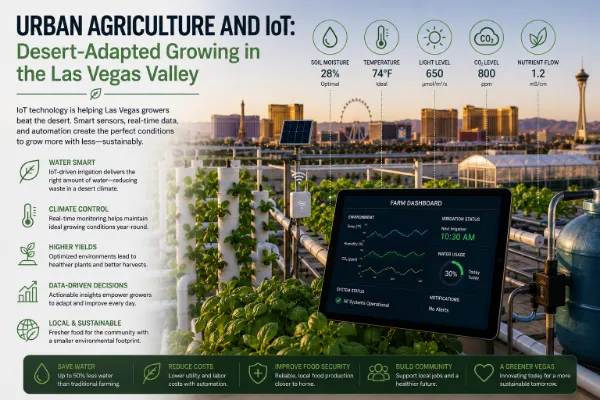
Across every one of these Las Vegas urban agriculture projects, continuous environmental monitoring isn't an optional efficiency upgrade it's the fundamental technology that makes growing food in this specific climate viable at all. A controlled-environment growing operation anywhere depends on maintaining stable temperature, humidity, and CO2 levels, but the margin for error shrinks considerably when the outdoor conditions a facility's climate control system has to counteract include sustained summer temperatures well above 100 degrees for extended periods. Continuous sensor monitoring that can detect and respond to a developing climate control problem within minutes, rather than hours, matters more in Las Vegas specifically than it would in a facility only needing to manage a milder, more forgiving outdoor climate swing.
Given how much of Las Vegas's urban agriculture infrastructure depends on corporate philanthropy and grant funding rather than pure commercial revenue MGM Resorts' direct investment in the James Gay Park facility being the clearest example organizations running these projects increasingly need to demonstrate measurable outcomes to sustain continued support. Yield data, water use efficiency metrics, and community reach numbers like Zion Urban Farm's documented 500-families-a-month figure all depend on exactly the kind of continuous IoT monitoring and data logging covered throughout this article, making the technology as much a fundraising and accountability tool as an operational one. This funding-driven pressure is arguably as significant a driver of continued IoT investment in Las Vegas's urban agriculture sector as any pure operational efficiency argument on its own.
Despite spanning corporate philanthropy, university research, grassroots community organizing, and ambitious new sustainability-focused startups, Las Vegas's urban agriculture projects share a consistent underlying logic: none of them are trying to replicate traditional soil-based farming in a climate genuinely hostile to it. Every project covered here relies on some combination of hydroponic, aeroponic, or fully climate-controlled growing specifically because these approaches sidestep the water and heat constraints that make conventional outdoor agriculture in the Las Vegas Valley genuinely impractical at meaningful scale a technology-first approach that distinguishes the Valley's urban farming movement from the community-garden model more common in cities with milder growing climates.
Frequently asked questions
Its two climate-controlled growing containers, totaling just 320 square feet, produce output equivalent to nearly 3.5 acres of traditional farmland roughly eight tons of produce annually.
MGM Resorts International donated $500,000 to the Mayor's Fund for Las Vegas LIFE, which underwrote the purchase of the two climate-controlled growing containers.
Researchers at the North Las Vegas Learning Center track temperature, humidity, and carbon dioxide levels at each stage of plant growth to identify optimal environmental conditions for indoor farming specifically adapted to Southern Nevada's climate.
The North Las Vegas farm, which opened in 2024, now serves as many as 500 families a month with free produce, alongside distributing micro-grants to help community members start their own home gardens.
Beyond water-efficient closed-loop hydroponic and aeroponic systems, the project explicitly uses vertical greenery to create localized cooling zones reducing ambient urban heat, and incorporates transparent solar glazing to power growth lighting from the same structure housing the crops.
With outdoor temperatures regularly exceeding 100 degrees for extended periods, a controlled-environment growing operation's climate control system has a much smaller margin for error, making rapid sensor-based detection of developing problems more critical than in a milder climate.
Related articles

 Agriculture IoT