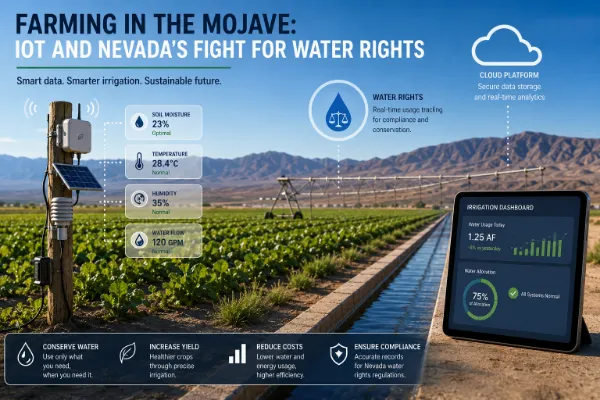
Nevada's 2026 Colorado River allocation cut holds at 7%, the fifth consecutive year of mandatory reductions since shortage conditions first began in 2022 and unlike Arizona, which has absorbed the deepest cuts among Lower Basin states, Nevada's farmers are managing these reductions against an allocation that was already small to begin with, covered in more detail in this site's coverage of the state's broader agricultural water rights history. For the growers who remain, precision irrigation technology has moved from a helpful efficiency measure to something closer to an operational necessity, given how directly every gallon saved translates into continued economic viability under a shrinking, uncertain water supply.
Nevada's agricultural specialty in high-value alfalfa seed production more than 5,000 acres overseen by the state's Seed Certification Program, producing some of the highest-protein, highest-value alfalfa in the country creates a genuine tension worth understanding. Alfalfa is often cited nationally as a water-intensive crop, and roughly 62% of all agricultural Colorado River water basin-wide supports growing cattle feed like alfalfa and grass hay. But Nevada's alfalfa operation is fundamentally different from the large-scale, lower-value hay production common elsewhere in the basin this is specialty seed stock, exported nationally and internationally at premium prices, meaning the economic return per unit of water applied runs considerably higher than a bulk commodity hay operation would generate. That economic reality changes the precision irrigation calculation directly: with alfalfa seed commanding premium pricing, the case for tightly optimized, sensor-driven irrigation that maximizes yield per gallon rather than simply minimizing total water use becomes considerably stronger than it would for a lower-value bulk crop.
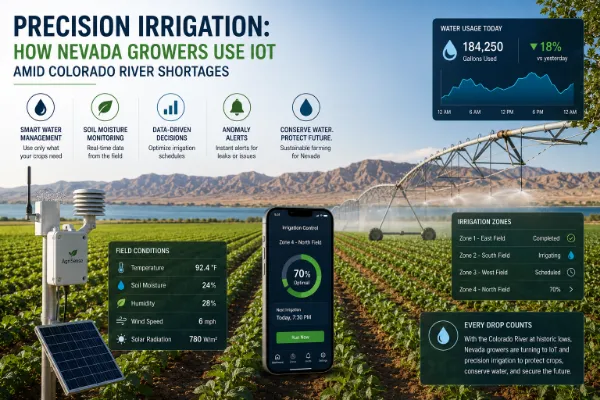
For the working farms remaining in Clark County's Northeast County communities along the Virgin River, and the smaller cluster of operations around Pahrump, precision irrigation deployment follows patterns familiar from other water-constrained Western growing regions but adapted to genuinely small operational scale. Continuous soil moisture sensors at multiple root-zone depths provide direct, real-time measurement rather than requiring growers to estimate irrigation needs from visual inspection or a fixed calendar schedule critical for a region where every irrigation decision carries real economic weight given the constrained underlying water allocation. Evapotranspiration-based scheduling, calculating actual crop water loss based on real weather conditions rather than a fixed schedule, helps growers avoid both the yield loss from underwatering and the wasted allocation from overwatering, a genuinely narrow target given how directly every wasted gallon reduces what remains available for the rest of a growing season already operating under a reduced allocation.
Some of Nevada's smaller agricultural operations have pursued genuine crop diversification specifically as a response to water constraints Moapa Valley High School's working farm, covered in more detail in this site's coverage of Nevada's broader water rights situation, has found notable success with a pomegranate orchard alongside its more traditional alfalfa hay and cattle operations, part of a broader pattern where smaller Nevada growers increasingly favor higher-value, lower-water-demand specialty crops over traditional water-intensive commodity production. Precision irrigation technology plays a particularly important role in this kind of diversification, since a specialty fruit crop typically has a narrower, less forgiving water tolerance window than an established commodity crop a region has grown for generations getting irrigation timing and volume right matters more, and the margin for costly trial-and-error learning is smaller, when a grower is establishing a genuinely new crop type in a water-constrained environment.
University of Nevada Cooperative Extension maintains research infrastructure directly relevant to precision irrigation decisions facing the state's remaining growers, including a one-acre outdoor research orchard in the Las Vegas area studying growing conditions specific to the region. This kind of local extension research matters considerably for Nevada's smaller-scale growers specifically, since national or regional irrigation efficiency data often generated from research in larger, better-resourced agricultural states doesn't always translate cleanly to Nevada's specific combination of extreme heat, limited water allocation, and predominantly small farm scale. Growers able to draw on locally calibrated extension guidance, rather than relying purely on generic irrigation efficiency benchmarks, are better positioned to correctly interpret what their own sensor data is actually telling them about a specific crop's needs under Nevada's particular growing conditions.
Across documented precision irrigation deployments broadly, sensor-based systems commonly reduce water use by 30% to 50% while improving yield consistency, with typical return-on-investment timelines of 1.5 to 2 years for well-implemented systems. For Nevada's remaining growers operating under an allocation that's already been cut for five consecutive years with further reductions genuinely possible depending on how the broader Colorado River Basin negotiation process resolves, that kind of water savings carries a different, more existential weight than it would for a grower in a state with a larger, more secure water allocation to work with every percentage point of efficiency gained represents genuine additional operational runway under continued uncertainty, not just a modest cost reduction.
Beyond the direct water savings, continuous, sensor-based irrigation monitoring generates something that may prove equally valuable to Nevada's remaining agricultural water rights holders over time: a documented, verifiable record of efficient water use. As the broader Colorado River Basin works through establishing new long-term management guidelines beyond the current short-term bridge agreement, covered in more depth in this site's coverage of Nevada's water rights situation, growers who can demonstrate precise, minimized, and thoroughly documented water consumption are likely to be in a stronger position navigating whatever new allocation or compensation framework eventually emerges than those relying on estimated or unverified usage patterns making the data-generation function of precision irrigation technology worth as much, in the long run, as the water savings it delivers in any single growing season.
For a Nevada grower evaluating precision irrigation investment for the first time, a sensible approach starts with soil moisture sensing on the specific crop or field block generating the highest economic return per acre the specialty alfalfa seed operations or diversified specialty crops like pomegranates covered above, rather than lower-value acreage where the return on a sensor investment takes longer to materialize. From there, connecting with University of Nevada Cooperative Extension's local research resources before committing to a specific commercial platform helps ensure whatever technology gets deployed is calibrated to Nevada's actual growing conditions, rather than generic irrigation efficiency assumptions imported from a wetter or less water-constrained agricultural region.
Frequently asked questions
Nevada specializes in high-value alfalfa seed stock rather than bulk commodity hay, commanding premium national and international pricing, which strengthens the economic case for precision irrigation that maximizes yield per gallon rather than simply minimizing total water use.
Documented deployments commonly show water use reductions of 30% to 50% with typical return-on-investment timelines of 1.5 to 2 years, though the practical stakes are higher for Nevada growers given the state's already-constrained water allocation.
Some are. Operations like Moapa Valley High School's farm have added specialty crops like pomegranates alongside traditional alfalfa and cattle operations, favoring higher-value, potentially lower-water-demand specialty production.
Yes. The university maintains research infrastructure including a Las Vegas-area outdoor research orchard studying growing conditions specific to the region, providing locally calibrated guidance that generic national irrigation data doesn't always capture.
As the Colorado River Basin negotiates new long-term water management guidelines, growers able to demonstrate precise, verified water efficiency may be better positioned under whatever new allocation or compensation framework eventually emerges.
Specialty crops typically have narrower, less forgiving water tolerance windows than established commodity crops, making precise irrigation timing and volume more critical, especially when a grower is establishing a genuinely new crop type in a water-constrained region.
Related articles

 Agriculture IoT