Fashion Show Mall, the Strip's largest shopping destination at roughly 2 million square feet with more than 250 stores, illustrates something genuinely distinctive about how Las Vegas retail actually operates. Industry analysis of the property has specifically noted that its unusually broad mix of market tiers under one roof from Neiman Marcus and Saks Fifth Avenue down to Forever 21 and mainstream mall brands isn't a leasing inconsistency, it's a direct response to who actually walks through the doors: conventioneers and luxury travelers generating high-spend occasion visits, alongside Summerlin, Henderson, and northwest valley residents who treat the mall as their primary neighborhood shopping center. Few retail markets anywhere ask a single store to serve both a once-a-year convention visitor with luxury purchasing intent and a local resident on a routine shopping trip, and that dual customer base genuinely shapes what smart shelf and inventory technology needs to prioritize here.
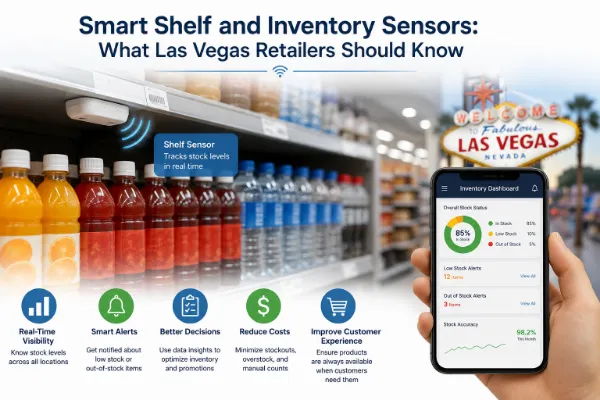
The category spans several genuinely distinct technologies:
- Electronic shelf labels (ESLs): E-ink or LCD price tags updating remotely and instantly, eliminating manual paper tag changes.
- Weight sensors: Shelf-integrated scales detecting product removal or restocking, converting weight changes into inventory counts.
- RFID tagging: Tags read by shelf or gateway antennas without requiring line of sight, supporting inventory accuracy and shrinkage detection simultaneously.
- Computer vision cameras: AI-paired cameras detecting empty shelf space or misplaced items visually.
A store operating in a Las Vegas Strip retail center faces a genuinely harder inventory forecasting problem than a comparable store in a purely local shopping center: demand is shaped simultaneously by predictable local shopping patterns and highly volatile, event-driven tourist and convention traffic that can shift dramatically week to week depending on what's happening at the Las Vegas Convention Center or which residencies and events are drawing crowds to the Strip that particular week. Smart shelf and inventory sensors that provide continuous, real-time visibility into actual sell-through rates rather than relying on periodic manual counts become considerably more valuable in this environment, since a retailer needs to detect and respond to demand shifts driven by an unpredictable convention calendar far faster than a traditional restocking cycle built around steady, predictable local demand would require.
Retail operating inside or immediately connected to a casino resort the Forum Shops at Caesars Palace, Grand Canal Shoppes at The Venetian, and similar properties woven directly into resort complexes faces an additional consideration that a standalone shopping center doesn't: 24/7 operating hours matching the surrounding casino floor's continuous operation, and integration considerations with the broader resort technology stack covered in more detail in this site's coverage of Strip resort smart building technology. A retailer in this environment benefits from inventory systems that can operate and restock effectively across a genuinely continuous operating schedule, rather than the defined opening-and-closing hours that shape inventory management logic in a conventional retail environment elsewhere.
Electronic shelf labels carry outsized value in Las Vegas's tourist-heavy retail corridors specifically because of how price-sensitive and comparison-prone this particular customer base can be visitors comparing souvenir, apparel, and accessory pricing across multiple nearby Strip properties within the same shopping trip, often while actively checking prices on a phone in real time. The ability to adjust pricing instantly in response to a competitor's move, run a flash promotion tied to a specific event or convention window, or dynamically price inventory approaching end-of-season without manually re-tagging an entire store gives Las Vegas retailers a genuine tactical advantage in an environment where pricing comparison happens more actively and more visibly than in a typical suburban retail corridor.
- Start with electronic shelf labels in categories tied to event-driven demand, since these deliver the fastest measurable return by letting a retailer respond quickly to a specific convention or Strip event window rather than waiting for a scheduled price update cycle.
- Add weight-based inventory sensors to high-velocity categories most exposed to tourist demand volatility, rather than instrumenting an entire store uniformly, prioritizing the SKUs most likely to sell out unpredictably during a major convention or event.
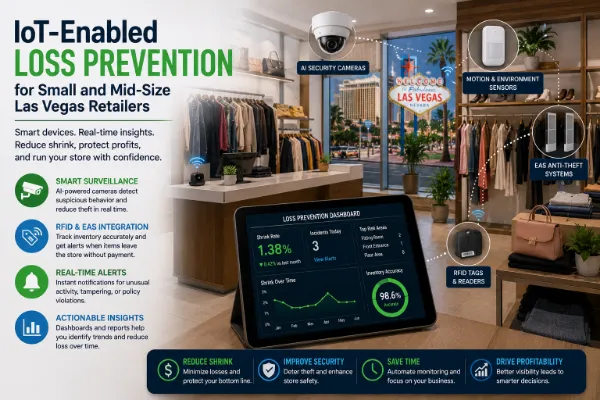
- Layer in RFID for high-shrinkage categories, a priority covered in more depth in this site's coverage of loss prevention for Las Vegas retailers specifically, given how the region's organized retail theft environment shapes which categories deserve this investment first.
- Evaluate computer vision once baseline inventory data is trusted, since it delivers the most value layered on top of an already-functioning data foundation.
Retailers evaluating smart shelf vendors for Las Vegas locations should push past generic product demonstrations and ask questions specific to this environment. Does the vendor have experience with retail environments facing genuinely volatile, event-driven demand swings, rather than only steady-state suburban retail case studies that don't reflect how directly a specific week's convention calendar can shift local sell-through rates? Given the premium rents in Strip-adjacent retail corridors, what's the actual installation timeline, since extended downtime carries a higher opportunity cost in a high-traffic tourist location than in a lower-volume market? And can the platform demonstrate integration with point-of-sale and loss prevention systems already in place, given how directly inventory accuracy and shrinkage detection are linked in a market with Las Vegas's documented organized retail crime challenges, covered in more depth elsewhere on this site?
Electronic shelf labels typically run from a few dollars to around ten dollars per label depending on size and display type a modest incremental cost relative to the real estate investment already required to operate in premium Strip corridors like Fashion Show, the Forum Shops, or the Grand Canal Shoppes. Weight sensor and RFID infrastructure costs vary more by scale, but modular, retailer-scale systems have become considerably more accessible than the enterprise platforms originally built for national big-box chains, a shift that's made this technology realistic for the independent boutiques and specialty retailers that make up a meaningful share of Las Vegas's Strip retail mix, not just large anchor department stores.
One underused resource for a retailer newly evaluating smart shelf technology in Las Vegas's Strip retail centers: property management at properties like Fashion Show, the Forum Shops, and Grand Canal Shoppes generally has visibility into which tenants have adopted various operational technologies, given how closely these operators track tenant performance as part of ongoing lease relationships. A newer retailer entering any of these properties can reasonably ask property management or, where relationships allow, neighboring tenants directly about their experience with specific smart shelf vendors, rather than evaluating the technology purely from vendor sales materials and generic industry case studies that may not reflect the specific operational realities of Las Vegas's unusual customer mix.
Frequently asked questions
Demand is shaped simultaneously by predictable local shopping patterns and highly volatile, event-driven tourist and convention traffic that can shift dramatically week to week, requiring faster detection and response than a steady local demand pattern would.
Yes. Stores operating inside resort properties like the Forum Shops or Grand Canal Shoppes benefit from inventory systems built around continuous, 24/7 restocking capability matching the surrounding casino floor's operating schedule.
Tourist customers frequently comparison-shop across multiple nearby Strip properties in real time, making instant pricing adjustments and event-driven flash promotions a genuine competitive advantage compared to a slower, manual repricing process.
It serves both high-spend luxury tourists and conventioneers alongside local Summerlin and Henderson residents using the mall as their primary shopping destination, requiring stores to serve genuinely different customer segments simultaneously rather than one consistent local demographic.
No. A phased approach starting with categories most exposed to event-driven demand volatility, then expanding to high-shrinkage categories, tends to deliver better returns than broad, undifferentiated coverage from day one.
Yes. Modular, retailer-scale systems have become accessible enough in cost that independent specialty retailers common in Strip shopping centers can adopt this technology alongside larger anchor stores.
Related articles

 Retail IoT