Las Vegas ranked sixth nationally for organized retail crime in the National Retail Federation's 2025 "Impact of Retail Theft and Violence" report, and Clark County Sheriff Kevin McMahill has stated publicly that retail theft in Las Vegas is worse than in San Francisco a city that's become something of a national byword for the problem. Las Vegas Metropolitan Police Department statistics show shoplifting up 12.7% in 2026 compared to 2024, with organized retail crime specifically up 11% year over year in 2025. For small and mid-size Las Vegas retailers without a national chain's dedicated security budget, this isn't an abstract statistic it's a genuinely severe, well-documented local problem that's prompted a real law enforcement response, and IoT-based tools have become one of the more practical ways smaller operators can actually participate in fighting it.
LVMPD's Property Crimes Section has dismantled multiple sophisticated fencing operations in recent months, illustrating the genuinely organized structure behind much of the region's retail theft. One case involved a coordinator running an illegal online marketplace that fenced tens of thousands of dollars in stolen luxury items across state lines, sourcing merchandise from localized "boosters" street-level thieves specifically targeting high-end apparel, premium cosmetics, and consumer electronics from valley storefronts before shipping the stolen goods through digital storefronts on legitimate online marketplaces. A separate case uncovered a scheme built around stolen diabetic blood sugar test strips valued at roughly $280,000, illustrating how these organized networks target a genuinely wide range of product categories, not just the obvious luxury goods that get the most media attention.
LVMPD restarted its dedicated Organized Retail Crime Detail, now staffed with eight detectives and two administrators under Sergeant Patrick Flynn, specifically to investigate the distribution and resale of stolen merchandise and work directly with retail partners to identify crime trends and target repeat offenders. This detail meets regularly with 50 to 75 retailers to discuss crime trends and concerns, a genuine local resource smaller retailers should know exists and can engage with proactively rather than only reaching out after an incident occurs. Henderson Police Department has run its own coordinated retail theft operations as well a Black Friday 2025 effort stationing detectives at major retail stores resulted in 19 arrests, 11 citations, and more than $5,200 in recovered stolen merchandise in a single day, part of a broader year that saw HPD recover more than $7,000 in stolen goods.
Before investing in any technology, it's worth being honest about the actual composition of a store's shrinkage. Industry-wide, external theft accounts for roughly 36% of losses, internal theft by employees another 30% to 40%, and administrative error the remainder meaning a retailer who assumes their losses are purely an organized-crew shoplifting problem may be missing a substantial share of their actual shrinkage, which requires different detection tools: point-of-sale exception reporting and back-office access controls rather than cameras aimed purely at the sales floor.
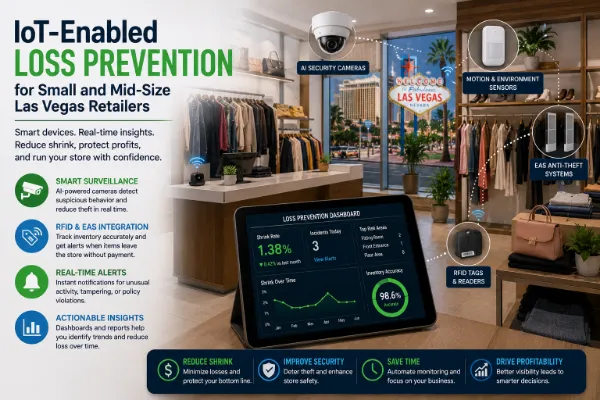
For most small and mid-size Las Vegas retailers, the most cost-effective entry point isn't new camera hardware it's AI-driven video intelligence layered onto cameras a store likely already has installed. Modern platforms connect existing video feeds to point-of-sale data, flagging specific behavioral patterns rather than requiring a human to review hours of raw footage. The patterns these systems increasingly detect map directly onto what LVMPD's documented cases reveal about local organized theft tactics: coordinated group activity, systematic concealment behavior consistent with "boosters" filling bags or carts, and the kind of repeated, methodical visits characteristic of a crew casing a location before a larger theft event patterns a single overworked employee is unlikely to reliably catch, especially given how brazen Metro officials have described these subjects as being, walking out with "trash bags or shopping carts full of product."
Given how consistently high-end apparel, premium cosmetics, and consumer electronics show up in Las Vegas's documented organized theft cases, RFID tagging on precisely these categories offers a cost-effective, targeted deployment rather than requiring store-wide tagging. A tagged item crossing an exit sensor without a corresponding point-of-sale transaction triggers an immediate, specific alert considerably faster and more actionable than traditional electronic article surveillance tags alone. Home Depot's own public affairs statements, describing wire, wiring devices, power tools, and home automation products as among its most targeted categories, illustrate that this problem extends well beyond the fashion and cosmetics categories that dominate media coverage any Las Vegas retailer selling easily resold, moderate-to-high-value merchandise should evaluate their own specific category risk rather than assuming only luxury goods retailers need this level of protection.
- Start with AI video analytics on existing cameras, the lowest-hardware-cost, broadest-coverage entry point for most smaller retailers.
- Add point-of-sale exception reporting to catch the internal theft and administrative error that external-theft-focused security programs typically miss.
- Layer in RFID for your highest-risk product categories, informed by what LVMPD's documented cases reveal about locally targeted merchandise types.
- Report every incident consistently, since Metro's own theft crimes leadership has specifically emphasized that comprehensive reporting is what allows them to identify trends and connect individual incidents to the broader organized networks behind them a well-documented, IoT-generated incident record is exactly the kind of evidence that supports this effort.
Given how well-documented Las Vegas's organized retail crime problem has become a national #6 ranking is exactly the kind of statistic an insurance underwriter is likely to be aware of it's worth a smaller retailer specifically asking their commercial insurance broker whether documented IoT-based loss prevention technology affects premium calculations or claims outcomes. Some carriers offer meaningful credits for verified continuous monitoring, and in a market where the local sheriff has publicly compared conditions unfavorably to San Francisco, insurers may increasingly expect to see documented prevention measures as a baseline underwriting expectation rather than an optional enhancement.
Nevada's congressional delegation has been directly involved in pushing federal legislation addressing this problem the Combating Organized Retail Crime Act, which would strengthen coordination among federal, state, and local law enforcement and create a federal coordination center within Homeland Security Investigations specifically targeting organized theft rings, has passed the U.S. House with bipartisan support and backing from Nevada representatives. For Las Vegas retailers, this signals that the resources and coordination infrastructure available for fighting organized retail crime are likely to expand rather than contract in the coming years, making early investment in the kind of well-documented, IoT-generated evidence trail that supports these broader investigations a genuinely forward-looking decision, not just an immediate loss-prevention measure.
Frequently asked questions
Las Vegas ranked sixth nationally in the National Retail Federation's 2025 retail theft report, and Clark County Sheriff Kevin McMahill has publicly stated that retail theft in Las Vegas is worse than in San Francisco.
Yes. The Organized Retail Crime Detail, staffed with eight detectives and two administrators, meets regularly with 50 to 75 retailers to discuss crime trends and encourages businesses to reach out proactively for information.
Documented cases show high-end apparel, premium cosmetics, consumer electronics, and even categories like diabetic test strips and home improvement products such as wire and power tools among frequently targeted merchandise.
External theft typically accounts for around 36% of shrinkage, internal theft by employees for 30% to 40%, and administrative errors for the rest, meaning a security strategy focused only on external shoplifters misses a large share of the actual problem.
AI-driven video analytics layered onto cameras a store already has installed typically offers the lowest-hardware-cost, broadest-coverage starting point before investing in RFID or dedicated access control systems.
Yes. The Combating Organized Retail Crime Act, backed by Nevada's congressional delegation, has passed the U.S. House and would create a federal coordination center specifically targeting organized theft rings.
Related articles

 Retail IoT