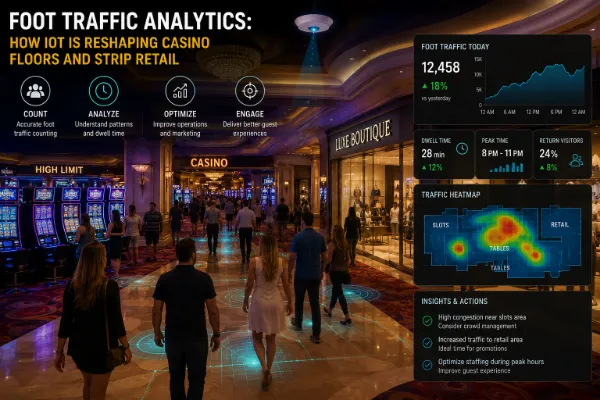
Walk from a casino floor into an adjacent Strip shopping center from Caesars Palace's gaming floor into the Forum Shops, or the Venetian's casino into the Grand Canal Shoppes and you cross from one foot traffic analytics environment into a genuinely different one, even though the physical transition might take only a few steps. Casino floor sensors and retail foot traffic sensors are solving related but distinct problems, and understanding that difference matters for how Las Vegas resort operators actually deploy this technology across their properties.
Motion sensors on a casino gaming floor, covered in more depth in this site's coverage of Strip resort smart building technology, primarily track guest movement to inform game popularity analysis, machine layout decisions, and security monitoring a fundamentally different objective than a retail store's foot traffic system, which is typically trying to understand conversion rate and optimize merchandising within a defined selling space. A casino floor doesn't have a checkout point the way a retail store does; the "conversion" being measured is closer to dwell time and engagement at a specific game or table than a discrete purchase transaction, which changes what kind of sensor data actually matters and how it gets interpreted operationally.
Once a guest crosses from the casino floor into an attached retail center like the Forum Shops or Grand Canal Shoppes, foot traffic analytics shifts to the more conventional retail framework entrance counters, zone-level dwell time tracking, and conversion analysis tied to actual purchase transactions. What makes this genuinely different from foot traffic analytics in a standalone suburban mall, covered in more general terms elsewhere on this site, is the customer mix flowing through a Strip retail center specifically: casino guests taking a shopping break between gaming sessions, hotel guests exploring the property during a multi-day stay, convention attendees with fundamentally different time constraints and purchasing intent than a typical weekend mall shopper, and locals who use these same retail centers as their regular shopping destination despite their location inside a tourist-oriented resort.
A genuinely practical operational question for resort properties with attached retail is whether and how casino floor traffic data and retail foot traffic data should inform each other. A guest's movement pattern crossing from the casino floor into the attached shopping center represents a meaningful behavioral signal someone who just left a gaming session and is now browsing retail may represent a different purchasing mindset than someone who arrived directly from their hotel room specifically to shop. Some resort operators have begun exploring whether combining these previously separate data streams respecting the different regulatory and privacy considerations that apply to gaming floor data specifically, covered in more depth in this site's coverage of Nevada Gaming Control Board technical standards can reveal genuinely useful cross-selling and property-wide traffic flow insights that neither system captures on its own.
Las Vegas retail foot traffic, whether in a Strip-adjacent center or an off-Strip mall like Fashion Show, responds to the region's event and convention calendar in ways that create genuinely larger traffic swings than a typical American retail market experiences. A major trade show at the Las Vegas Convention Center, covered in more detail in this site's coverage of the venue's own technology infrastructure, can send tens of thousands of additional visitors through nearby retail corridors within a tight, predictable window a demand pattern that continuous foot traffic sensor data helps retailers anticipate and staff for specifically, rather than relying on generic seasonal retail planning templates that don't account for how directly a specific week's convention schedule shapes local retail traffic.
Las Vegas retail foot traffic follows a genuinely different weekly rhythm than most American retail markets, where weekend traffic typically dwarfs weekday volume. Given the city's heavy reliance on midweek convention and business travel, many Strip-adjacent retail centers see meaningfully strong weekday traffic driven by conventioneers with schedule gaps between sessions, alongside the more traditional weekend surge driven by leisure tourists and locals. Foot traffic analytics that simply apply a generic "weekday versus weekend" staffing template, without accounting for this locally specific pattern, risk understaffing during exactly the midweek periods when a major convention is in town and overstaffing during weekends that happen to fall between major events on the calendar.
- Staffing precision tied to the actual convention calendar, rather than generic day-of-week retail staffing templates, given how dramatically Las Vegas foot traffic can shift based on what's happening at the Convention Center or on the Strip that specific week.
- Layout and merchandising decisions informed by dwell-time data segmented by likely customer type, distinguishing tourist browsing patterns from local resident shopping trips where the underlying sensor technology and analytics platform support this kind of segmentation.
- Cross-property traffic analysis for retailers with locations in multiple Strip shopping centers, comparing performance across the Forum Shops, Grand Canal Shoppes, and Fashion Show to understand which specific property and customer mix drives the strongest results for a given product category.
For most Las Vegas retailers, a single well-placed entrance or zone counter paired with basic dwell-time tracking delivers the bulk of actionable insight at a fraction of the cost of full computer-vision deployment. Entry-level thermal or infrared entrance counters typically run a few hundred to around $1,650 in hardware cost, plus modest monthly software fees a reasonable starting investment even for a smaller retailer operating in a single Strip-adjacent location. Given the outsized value of accurately anticipating convention-driven demand swings in this specific market, retailers with the scale to justify it increasingly find the case for integrating foot traffic data directly with the region's public convention and event calendars more compelling here than in a market with more uniform, less event-driven traffic patterns.
For retailers leasing space inside a resort-operated shopping center rather than a standalone location, it's worth clarifying upfront whether foot traffic data collected by the property's own sensor infrastructure is available to individual tenants, and under what terms. Some Strip shopping center operators share aggregate foot traffic data with tenants as part of the leasing relationship, giving an individual store owner useful context about overall property-wide patterns even without deploying their own dedicated sensors a genuinely different arrangement than a standalone retailer would have, and one worth understanding fully before deciding whether to invest in redundant, store-level foot traffic technology or rely primarily on data the property itself already collects and shares.
Frequently asked questions
Casino floor sensors primarily track guest movement for game popularity analysis, machine layout, and security, while retail foot traffic analytics focuses on conversion rate and merchandising optimization tied to actual purchase transactions genuinely different objectives even within the same resort property.
Yes. Major conventions and Strip events can send tens of thousands of additional visitors through nearby retail corridors within a tight, predictable window, creating larger and more event-driven traffic swings than most American retail markets experience.
Some resort operators are exploring this, though it requires respecting the distinct regulatory and privacy considerations that apply specifically to gaming floor data under Nevada Gaming Control Board requirements.
The mall serves both tourist and convention visitors with occasion-driven shopping behavior and local residents using it as a routine shopping destination, requiring analytics that can distinguish between genuinely different customer segments and purposes.
A single well-placed entrance or zone counter with basic dwell-time tracking typically delivers most of the actionable insight without the cost of a full computer-vision deployment.
Integrating foot traffic analytics with the region's public convention and event calendar lets retailers staff proactively for known demand spikes, rather than relying on generic seasonal templates that don't account for a specific week's convention schedule.
Related articles

 Retail IoT