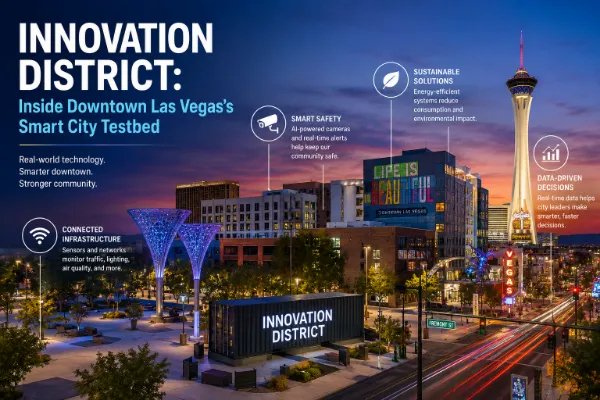
Beneath the streets of downtown Las Vegas runs 123 lane-miles of fiber optic cable, laid specifically to let autonomous vehicles and connected infrastructure operate through the heart of the city. This is the physical backbone of the Innovation District, a designated downtown zone the City Council opened specifically to high-tech transportation testing a deliberate decision to concentrate smart city experimentation in one defined, manageable area rather than attempting a citywide rollout of unproven technology all at once.
The Innovation District model reflects a genuinely different approach than either San Diego's or San Jose's early smart city efforts, both covered in more depth elsewhere on this site rather than announcing a sweeping citywide sensor vision and scaling it up from there, Las Vegas designated a specific downtown zone explicitly as a place for technology companies to test inventions in a real urban environment before any larger investment decision gets made. This approach lines up with Las Vegas's designation as a US Ignite Smart Gigabit Community, and the city has organized its work around four core project areas: autonomous vehicle development, connected vehicle corridor deployment, open data facilitation, and smart city infrastructure creation.
City officials have described connecting roughly 10 downtown intersections with cameras that count vehicles, pedestrians, and bicyclists, alongside air quality monitoring equipment instrumentation aimed at calibrating signal timing to keep traffic moving and reduce the CO2 emissions generated by idling vehicles at congested intersections. These same smart intersections were designed to function as part of a connected corridor specifically built to let autonomous vehicles safely carry passengers through downtown, an explicit design goal from the district's earliest planning stages rather than a capability added after the fact.
The technology partnerships behind this infrastructure have shifted over time as the district has matured. An early collaboration with Cisco brought a Smart+Connected digital platform designed to feed real-time IoT device and sensor data to city leadership for operational decision-making. A separate partnership with NTT deployed video cameras and sound sensors specifically to improve traffic management within a defined Innovation District test area, paired with a downtown briefing center meant to help residents and visitors understand the practical benefits of connected community infrastructure a deliberate transparency and education component that distinguishes Las Vegas's approach from cities that deployed sensor technology first and explained it to residents only after facing pushback.
Smart city technology in Las Vegas isn't confined strictly to the Innovation District's transportation focus the broader city has tested sensors that alert public works staff when garbage cans are filling up, and monitors that track pedestrian jaywalking patterns to inform crosswalk and signal design decisions. This wider testing program reflects a consistent philosophy across the city's smart city efforts: test technology at a manageable scale first, with clear, measurable goals, before committing to a larger citywide investment an approach that helped Las Vegas earn a 2018 Readiness Challenge Grant from the Smart Cities Council, an honor the organization specifically credited to the city's focus on cross-department coordination and inclusion of underserved populations in its planning process, rather than technology deployment alone.
The Innovation District's original public goals, articulated under then-Mayor Carolyn Goodman's administration, included a target of becoming a fully connected smart city by 2025 a deadline that has now passed, and the honest assessment is that the district's actual scope remains more modest and more narrowly focused than that early framing suggested, concentrated specifically in downtown's transportation corridor rather than expanding into the kind of comprehensive citywide sensor network the phrase "fully connected smart city" implies. Under current Mayor Shelley Berkley, sworn in December 2024, the city's public technology and innovation focus has broadened to include priorities like a new downtown biohealth research lab and continued Arts District development, suggesting the Innovation District's transportation-testing mission remains an active but no longer singularly dominant piece of the city's broader innovation agenda.
Running parallel to the official Innovation District program, a community-driven initiative called Smart City Vegas has organized what it calls the Smarter Smart City Challenge, an open, collaborative hackathon-style program running through all of 2026 and into January 2027, inviting coders, community members, and anyone interested to develop novel ideas for improving Greater Las Vegas through technology. This kind of grassroots, community-organized layer distinct from and not directly run by city government reflects a genuinely different model of smart city development than the top-down, vendor-partnership approach that defines most of the Innovation District's formal city-led work, and it's worth watching whether ideas generated through this more open, participatory process eventually feed back into the city's own formal technology planning.
The Innovation District's connected vehicle corridor doesn't operate in a regulatory vacuum Nevada was actually one of the first states in the country to pass legislation explicitly authorizing autonomous vehicle testing, giving the state a genuine head start relative to many other jurisdictions still building out their own AV regulatory frameworks. This early regulatory clarity is part of why Las Vegas was able to designate a dedicated downtown testing zone with the confidence that a functioning legal framework already existed to support whatever autonomous vehicle activity the district's fiber and sensor infrastructure was built to enable, rather than needing to simultaneously build both the physical infrastructure and the underlying legal permissions from scratch.
For other cities evaluating how to approach smart city technology investment, Las Vegas's Innovation District offers a genuinely useful contrast to the more common pattern of announcing an ambitious citywide vision first and scaling technology deployment to match it a pattern that, as San Diego's original smart streetlight program and San Jose's broader 2016 Smart City Vision both illustrate in coverage elsewhere on this site, can create a gap between announced ambition and actual delivered capability. By explicitly designating a bounded testbed area and building specific, measurable pilot projects ten intersections, a defined connected vehicle corridor, specific sensor categories rather than announcing a sweeping citywide transformation, Las Vegas built in a natural mechanism for learning what actually works at manageable scale before committing to expand it further.
The core transferable lesson from Las Vegas's Innovation District isn't any specific technology choice it's the underlying project management discipline of defining success narrowly before scaling broadly. A city considering its own downtown testbed can reasonably start with the same basic questions Las Vegas answered concretely: which specific intersections, which specific sensor categories, and which specific measurable outcome define success before expansion gets considered. Cities that skip this step and instead announce a sweeping, undefined smart city transformation tend to struggle to demonstrate concrete results years later, precisely the gap that's shown up in some of San Jose's broader 2016-era smart city ambitions covered elsewhere on this site a contrast that makes Las Vegas's narrower, more disciplined approach a genuinely useful reference point regardless of whether another city's specific technology priorities match its transportation-testing focus.
Frequently asked questions
It's a designated downtown zone the City Council opened specifically for testing high-tech transportation and smart city technology, built around 123 lane-miles of fiber optic cable supporting autonomous vehicle and connected infrastructure testing.
Roughly 10 downtown intersections have been equipped with cameras counting vehicles, pedestrians, and bicyclists, along with air quality monitoring, aimed at calibrating signal timing to reduce congestion and idling emissions.
Not in the comprehensive sense the original goal implied. The Innovation District's actual scope has remained more narrowly focused on downtown's transportation corridor rather than expanding into a citywide sensor network.
Shelley Berkley has served as mayor since December 2024, and the city's public innovation focus has broadened under her administration to include priorities like a downtown biohealth research lab alongside the Innovation District's continuing transportation-testing work.
It's a community-organized initiative distinct from official city government programs, running an open "Smarter Smart City Challenge" hackathon-style program through 2026 into January 2027, inviting community members to develop technology ideas for improving Greater Las Vegas.
Designating a specific downtown zone let the city test technology at manageable scale with measurable pilot projects before committing to broader investment, an approach that helped it earn national recognition including a 2018 Smart Cities Council Readiness Challenge Grant.
Related articles

 Smart Cities