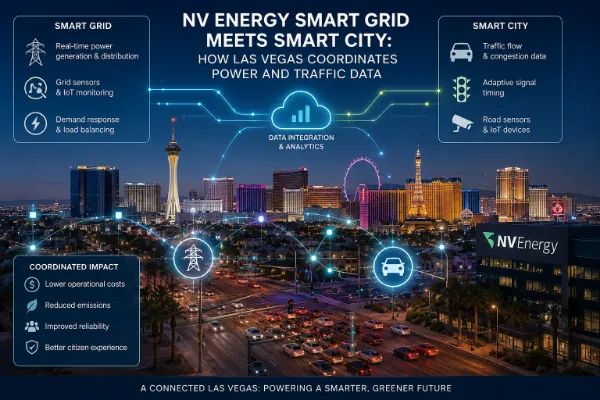
Southern Nevada runs two genuinely extensive, mature IoT sensor networks in parallel: NV Energy's smart electrical grid, built on more than 1.2 million smart meters installed across the utility's territory, and RTC FAST's traffic management system, covered in more detail elsewhere on this site, running nearly 1,700 signals and over 1,100 cameras. Both systems are individually sophisticated. What's worth examining honestly is how much these two systems actually talk to each other in 2026 and the honest answer is: less than the phrase "smart city" might suggest, though the natural intersection points between power demand and traffic patterns are becoming harder to ignore as both systems mature.
NV Energy's NVEnergize program, completed with federal Smart Grid Investment Grant support, installed 1,202,248 smart meters across the utility's residential and commercial customer base a program that also built out a meter data management system, a demand response management system, and an energy management system, all feeding into the MyAccount customer portal that gives Nevada ratepayers visibility into hour-by-hour energy consumption. The utility's mPowered demand response program uses programmable communicating thermostats linked to a web interface, allowing NV Energy to coordinate customer-side load reduction during periods of high system demand genuinely useful infrastructure for a utility serving 2.4 million electric customers across more than 44,000 square miles, plus a tourist population exceeding 40 million visitors annually who add substantial, concentrated demand to the Strip resort corridor specifically.
Few utilities anywhere have to plan grid capacity around a demand pattern shaped as heavily by tourism as NV Energy does. A major convention, a Strip residency opening, or a large-scale event can add tens of thousands of visitors to a concentrated few square miles almost overnight, each drawing air conditioning, elevators, casino floor lighting, and entertainment production power simultaneously a demand spike that has almost nothing to do with typical residential or commercial load patterns and everything to do with event scheduling that NV Energy doesn't control directly. This is precisely the kind of scenario where power demand data and traffic or event data genuinely would benefit from talking to each other: knowing in advance that a major event is drawing significant vehicle traffic into the resort corridor is also a reasonably strong signal that the same event will drive a concentrated electricity demand spike in the same geographic area at roughly the same time.
The honest state of integration between these two systems in 2026 is best described as adjacent rather than unified. NV Energy's demand response and smart grid systems operate primarily around utility-side load management thermostats, pricing signals, and system-wide demand forecasting while RTC FAST's traffic sensor network operates independently, focused on vehicle and pedestrian flow rather than energy consumption. There's no single, publicly documented control system where a traffic sensor detecting a major event's arrival automatically triggers a corresponding grid demand response action, or vice versa. What does exist is a shared underlying data resource both systems could theoretically draw from: Clark County and the City of Las Vegas maintain public event calendars and permitting data that, in principle, both a utility planning demand response and a traffic agency planning signal timing could use as a leading indicator of an unusual demand day though whether these two entirely separate organizations, with separate governance, separate technology vendors, and separate regulatory oversight, actually coordinate around this shared signal in practice is considerably less certain than the phrase "smart city" implies.
One area where power and transportation infrastructure planning genuinely do have to coordinate, out of practical necessity rather than choice, is electric vehicle charging infrastructure. As EV adoption continues growing across Southern Nevada, NV Energy's grid capacity planning has to account for charging demand concentrated along the same major corridors RTC FAST manages for traffic a public DC fast-charging station along I-15 or the Beltway represents both a transportation infrastructure decision and a genuine grid capacity planning question simultaneously, requiring at least some coordination between the utility and transportation planning agencies regardless of whether their broader IoT sensor networks are formally integrated. This is a case where the underlying physical infrastructure forces a level of practical coordination between NV Energy and regional transportation planners that doesn't require the two organizations' full data systems to be unified just enough shared planning to make sure a proposed charging site actually has adequate grid capacity available before it gets built.
For NV Energy's smart grid and RTC FAST's traffic sensor network to move from parallel, independently operating systems toward something closer to genuinely coordinated smart city infrastructure, a few practical steps would need to happen: a shared data-sharing agreement and technical integration layer connecting the two organizations' otherwise separate systems, a defined governance structure clarifying which agency has decision authority when the two data streams suggest conflicting priorities, and a specific, well-scoped pilot use case event-driven demand forecasting is a reasonable candidate narrow enough to prove genuine value before either organization commits to a broader integration effort. This mirrors the same lesson evident in Las Vegas's Innovation District approach covered elsewhere on this site: narrow, well-defined pilot projects tend to succeed where broad, ambitious integration efforts often stall, and any future NV Energy-RTC coordination effort would likely benefit from following that same incremental pattern rather than attempting a sweeping, all-at-once data integration project.
Interestingly, some of the most sophisticated coordination between power demand and event-driven activity already happening in Southern Nevada occurs not at the utility-and-city level, but inside individual Strip resort properties themselves, covered in more depth in this site's coverage of casino smart building technology. A large resort's own facilities management team already correlates its internal event calendar a major fight, a residency show, a large convention booking with its own building management system's HVAC and lighting demand forecasting, essentially performing at a single-property scale exactly the kind of event-to-demand coordination that NV Energy and RTC FAST haven't yet formally built at a citywide level. This suggests that if broader power-traffic-event integration ever does happen regionally, resort operators' internal facilities management practices may offer a more immediately applicable template than trying to design an entirely new coordination framework from scratch.
It would be easy to describe Las Vegas's power and traffic infrastructure as a unified "smart city brain" coordinating grid and transportation data in real time the marketing language around smart cities generally invites exactly that kind of framing. The more accurate picture, and arguably the more useful one for other cities studying Las Vegas's experience, is that two genuinely sophisticated, mature IoT systems can operate successfully in parallel for years without being formally integrated, each delivering real value independently, while the case for connecting them more deeply remains real but still largely unrealized. That's not a failure specific to Las Vegas it reflects a broader pattern across nearly every U.S. metro area, where utility infrastructure and transportation infrastructure evolved under separate governance structures, separate funding streams, and separate regulatory bodies that don't naturally converge just because the underlying data would be more valuable if they did.
Frequently asked questions
NV Energy's NVEnergize program installed 1,202,248 smart meters across its residential and commercial customer base, completed with federal Smart Grid Investment Grant support.
Yes. Major conventions and Strip events can add tens of thousands of visitors to a concentrated area almost overnight, creating demand spikes for air conditioning, lighting, and entertainment power that have little to do with typical residential or commercial demand patterns.
Not in any formally documented, unified way as of 2026. The two systems operate independently, though they could theoretically draw on shared public event and permitting data as a leading indicator of unusual demand days.
Electric vehicle charging infrastructure is the clearest point of practical convergence, since a public charging station along a major corridor is simultaneously a transportation planning decision and a grid capacity question.
A shared data-sharing agreement, a defined governance structure for resolving conflicting priorities, and a narrow, well-scoped pilot use case would all be needed before broader integration between NV Energy and RTC FAST's systems could realistically happen.
No. It reflects a broader pattern across most U.S. metro areas, where utility and transportation infrastructure evolved under separate governance, funding, and regulatory structures that don't naturally converge without deliberate coordination effort.
Related articles
 Smart Cities