Most coverage of the Sphere focuses on the spectacle the 160,000-square-foot exterior LED screen, the haptic seats, the 16K interior display that's become the most photographed building in Las Vegas since it opened in September 2023. What gets less attention is the building management infrastructure running underneath all of it, quietly handling the same categories of environmental monitoring, HVAC control, and safety systems that any large venue depends on, just operating at a scale and data intensity that makes most conventional smart building comparisons feel almost quaint.
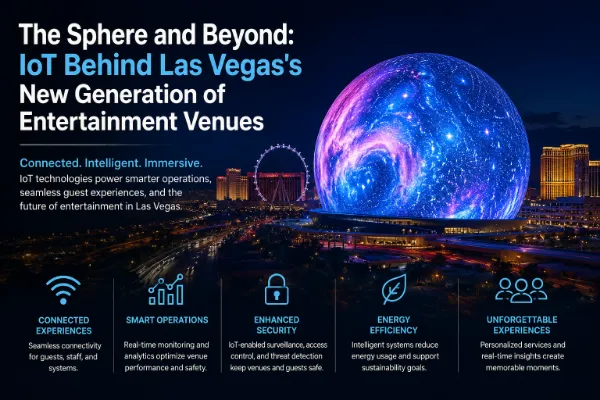
Beneath the headline-grabbing display technology, the Sphere incorporates extensive sensor networks and IoT devices continuously monitoring environmental conditions air quality, temperature, and crowd density feeding into centralized control units that dynamically optimize lighting, HVAC, and safety protocols in real time. This is the same fundamental "cognitive building" logic covered in this site's broader coverage of Strip resort smart building technology, just applied to a venue holding 17,600 seats and hosting shows that can shift crowd density and environmental load dramatically within a single evening, as a residency concert transitions from opening act to headline performance to encore.
The technical numbers behind the Sphere's core systems are genuinely extreme relative to typical commercial building technology: 4 petabytes of flash memory storage and a data transfer speed of 400 gigabytes per second, enabling ultra-high-resolution content playback with latency of roughly 5 milliseconds. That kind of infrastructure exists primarily to serve the content and display systems, but it also represents the same category of network backbone that a genuinely sophisticated building management system depends on moving environmental sensor data, safety system status, and crowd density information across the venue in real time requires network infrastructure built for volume and speed, and the Sphere's core data architecture, originally engineered for its visual and audio systems, happens to provide exactly that kind of capacity for everything else running through the building as well.
Sphere Immersive Sound, developed with Holoplot, illustrates how deeply sensor technology is woven into even the venue's entertainment systems, not just its facilities management. Hundreds of Holoplot X1 Matrix beamforming arrays sit behind the interior LED screen, and the system's proprietary algorithms use machine learning to synthesize creative input together with environmental data collected by sensors throughout the venue, continuously refining audio output based on actual conditions in the room rather than a fixed, pre-calibrated setting. The practical result, according to the production team, is designed to be simple for visiting artists to operate despite the underlying complexity a request for sound "here and over there" gets translated automatically into the precise beamforming configuration needed, with the sensor network handling the real-time environmental correction invisibly in the background.
Despite its scale and technological intensity, the Sphere incorporates solar panels, energy-efficient lighting, and smart climate control systems specifically aimed at reducing the venue's carbon footprint a genuinely notable design choice given how much raw power the venue's display and audio systems alone require. This pairing of technological maximalism with deliberate sustainability engineering reflects a broader pattern increasingly common across Las Vegas's newest venues: the assumption that a building this technically intensive can still be designed around efficient, sensor-optimized operation rather than treating high energy consumption as an unavoidable cost of spectacle.
Beyond its role as an entertainment venue, industry observers have described the Sphere as a prototype for how large-scale venues can integrate sustainability with technological sophistication more broadly its approach to blending environmental sensing, dynamic building management, and immersive production technology into a single, coherent system offers a genuine reference model for future large venues, not just in Las Vegas. That influence is already visible in how quickly major technology companies have moved to associate themselves with the building: Lenovo's global Tech World innovation event, historically held at company-selected venues worldwide, moved to the Sphere for its CES 2026 keynote the second consecutive year a major CES keynote has been delivered there explicitly to showcase the company's AI and infrastructure innovations inside a building that itself demonstrates what advanced, sensor-driven infrastructure can accomplish at scale.
The Sphere's emergence coincides with a broader concentration of IoT infrastructure showcasing happening in Las Vegas more generally, driven substantially by CES, held annually at the Las Vegas Convention Center. Exhibitors at CES 2026 explicitly built around IoT infrastructure themes spanning transportation, energy, waste management, wearable health devices, remote patient monitoring, and smart home automation, with tens of thousands of attendees identifying IoT infrastructure specifically as a business interest driving their attendance. This concentration of IoT industry activity in Las Vegas creates a genuine feedback loop: the same city hosting the world's largest showcase of connected technology is simultaneously home to venues like the Sphere actually deploying that technology at production scale, giving Las Vegas a uniquely dense concentration of both IoT vendors and IoT-intensive built infrastructure in one relatively compact geographic area.
One aspect of the Sphere's building management that's easy to overlook: the venue's environmental and crowd-density load varies far more dramatically, and far more unpredictably, than a typical commercial building's. Programming has ranged from concert residencies, including the venue's opening U2 run, to cinematic and VR-format shows, with a notable example being Phish's 2024 performances built around live 16K CGI composited in real time across the entire dome each format creating a genuinely different environmental and technical load profile than the last. A building management system tuned purely for a standard concert crowd pattern would be poorly suited to a format-shifting production schedule like this, which is part of why the venue's sensor and control systems are built around continuous, adaptive response rather than a fixed operating profile calibrated to a single, predictable use case.
As Las Vegas continues its long-running pattern of reinventing its entertainment infrastructure covered in more depth in this site's coverage of how the Strip retrofits and replaces its aging properties the Sphere has effectively raised the baseline expectation for what a major new venue's technology infrastructure should include. Future large-scale entertainment venues in the market, whether built independently or as part of a broader resort development, are likely to be evaluated at least partly against the Sphere's combination of environmental sensing, dynamic building management, and immersive production technology, even for venues with far more modest ambitions than matching its scale directly.
The Sphere's production capabilities extend even into custom camera hardware built specifically to feed its display systems the resolution they demand the Big Sky camera system, developed to capture content for the venue's screens, uses a sensor with roughly 40 times the resolution of a standard 4K camera, along with new data storage solutions engineered specifically to manage the resulting data volume. Camera manufacturers involved in the project have noted this pushed capability timelines they weren't expecting to need for roughly another decade, illustrating how the Sphere's requirements have functioned as a genuine forcing function for advancing sensor and imaging technology beyond what the broader market was otherwise driving toward on its own timeline.
Frequently asked questions
The venue uses extensive sensor networks tracking air quality, temperature, and crowd density, feeding into centralized control units that dynamically optimize lighting, HVAC, and safety protocols in real time.
The venue's systems include 4 petabytes of flash memory storage and a data transfer speed of 400 gigabytes per second, enabling ultra-high-resolution content playback with approximately 5 milliseconds of latency.
Sphere Immersive Sound, developed with Holoplot, uses machine learning algorithms that combine creative input with real-time environmental data collected throughout the venue to continuously refine and adjust audio output.
Yes. The venue incorporates solar panels, energy-efficient lighting, and smart climate control systems specifically intended to reduce its carbon footprint, despite the significant power demands of its display and audio systems.
Lenovo's Tech World event moved to the Sphere to showcase its AI and infrastructure innovations inside a venue that itself demonstrates advanced, sensor-driven building technology at scale, marking the second consecutive year a major CES keynote was delivered there.
CES draws thousands of IoT-focused exhibitors and attendees to the Las Vegas Convention Center annually, creating a concentration of both IoT vendors and IoT-intensive built infrastructure, like the Sphere, in a relatively compact geographic area.
Related articles

 Smart Buildings