Las Vegas has historically solved the problem of an aging casino resort with dynamite. The Desert Inn, Riviera, Sands, Stardust, Dunes, Hacienda, and Aladdin were all imploded over the decades, each making way for a new megaresort built essentially from bare ground. But as the Flamingo approaches its 80th anniversary in 2026 still standing at the literal center of the Strip, having outlasted virtually every property from its era a different pattern has become increasingly common: renovating and technologically upgrading an aging resort in phases, without ever fully closing, rather than tearing it down and starting over.
The Strip's classic reinvention pattern implode an aging property, build a new megaresort on the same footprint made economic sense when land value and construction costs made a full rebuild more attractive than incrementally upgrading dated infrastructure. That calculus has shifted considerably. The Flamingo's 80th-anniversary renovation, announced in late 2025, includes a completely redesigned lobby, an upgraded VIP check-in area, and a full revamp of the property's Bugsy's Bar gaming area a substantial capital investment, but one happening in phases around an operating resort rather than requiring the property to close entirely. Circus Circus, nearing 60 years old and sitting on the North Strip among considerably newer neighbors like Resorts World and Fontainebleau, has taken an even more deliberate approach: rather than competing directly with the technological spectacle surrounding it, the property has leaned into its history as a genuine differentiator, converting underused space an old storage room near the Adventuredome into a full bingo hall that draws lines of guests before doors even open.
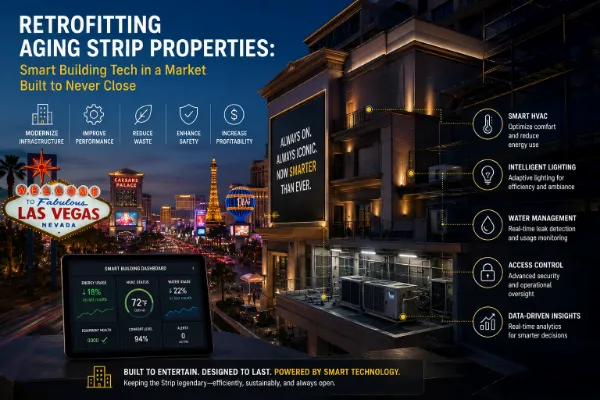
Smart building retrofit technology plays a genuinely practical role in making this incremental approach viable in a way it wasn't a generation ago. Modern wireless sensor networks, covered in more depth in this site's coverage of legacy equipment retrofits generally, allow a property to add environmental monitoring, occupancy sensing, and energy management capability to an aging building's specific zones without the extensive rewiring that would have required closing off large sections of an operating casino floor or hotel tower. This matters enormously in a market where every closed room and every roped-off casino section represents direct, immediate lost revenue a cost structure that makes minimally invasive, section-by-section retrofit work considerably more attractive than a comprehensive rebuild requiring extended closure.
Luxor illustrates the incremental pattern well: roughly half of the pyramid-shaped resort's 4,400 rooms were renovated as recently as 2021, a partial rather than comprehensive upgrade that left the remaining rooms on an older standard while modernizing a meaningful share of the property's inventory the kind of staged capital deployment that makes sense specifically because a property can keep generating revenue from its unrenovated half while investment concentrates on the renovated portion, rather than requiring the entire property to go dark during a full-scale overhaul.
It's worth being honest that this incremental retrofit pattern doesn't apply uniformly, and some Strip properties have fallen notably behind on modernization. Industry coverage has specifically flagged aging accommodations at several well-known Strip resorts visibly deteriorating finishes, pool areas that haven't kept pace with newer competing properties, and room technology that hasn't been meaningfully updated in years illustrating that the retrofit approach only works when ownership actually commits the capital to it. A resort that defers renovation indefinitely, rather than pursuing the kind of phased, technology-enabled upgrade path Flamingo and Luxor have taken, risks the same competitive erosion that has historically preceded either a change in ownership or, eventually, the kind of full teardown that defined the Strip's earlier reinvention cycles.
For an aging Strip property pursuing phased modernization rather than a full rebuild, the practical smart building investment sequence typically prioritizes a few categories: energy and water monitoring systems that can be retrofitted into specific zones without disrupting the rest of an operating property, given how directly utility costs affect a resort's margins at scale; occupancy-based HVAC and lighting controls in renovated sections, extending the "cognitive building" approach covered in this site's broader coverage of Strip resort technology into older infrastructure originally built without any such capability; and modernized guest room technology smart thermostats, app-based room controls, updated Wi-Fi and connectivity infrastructure concentrated in whichever specific room blocks are being renovated during a given phase, allowing a property to market "newly renovated" inventory at a premium rate while older, unrenovated rooms continue generating revenue at existing rates.
Even a phased, incremental retrofit on an aging Strip property has to navigate the same Nevada Gaming Control Board recertification requirements covered in this site's broader coverage of Strip resort technology any system upgrade touching gaming data, even as part of a section-by-section renovation, still requires the same regulatory review process a full new-build project would face. This adds a layer of planning complexity to phased renovation that a property's facilities team needs to account for explicitly: a retrofit schedule built purely around minimizing guest disruption still needs to build in time for gaming system recertification wherever a renovation phase touches casino-adjacent infrastructure, even indirectly.
The pace and ambition of a given property's retrofit strategy tends to correlate closely with ownership structure and long-term commitment to the specific site. Properties held by owners with a clear multi-decade horizon for the location the kind of commitment reflected in the Flamingo's deliberate 80th-anniversary investment tend to pursue more ambitious, technology-forward phased renovation than properties that have changed hands multiple times or sit under ownership weighing whether the site's long-term future is renovation, sale, or eventual redevelopment entirely. This is worth understanding as a genuine leading indicator: a Strip property's retrofit technology investment pattern often reveals more about ownership's actual confidence in the specific location's future than any public statement about renovation plans does on its own.
With new construction continuing on the Strip a Hard Rock hotel-casino replacing the former Mirage and a Major League Baseball stadium both advancing toward completion in 2026 the market retains its historic appetite for genuinely new megaresort development alongside the incremental retrofit pattern increasingly common at older properties. The more interesting long-term question is whether smart building retrofit technology, by making phased modernization genuinely viable without requiring a full closure, gradually shifts the Strip's historic boom-and-implosion cycle toward something closer to continuous, incremental renewal extending the useful competitive life of properties like the Flamingo well beyond what would have been realistic under the market's older, all-or-nothing reinvention model.
Frequently asked questions
Land value and construction economics historically favored building an entirely new megaresort on a cleared footprint rather than incrementally upgrading dated infrastructure, leading to the implosion of properties like the Desert Inn, Riviera, Sands, Stardust, Dunes, and Hacienda.
The resort, approaching its 80th anniversary in 2026 and among the oldest still standing on the Strip, is undergoing a phased renovation including a redesigned lobby, upgraded VIP check-in, and a revamped Bugsy's Bar gaming area.
Wireless sensor networks allow properties to add environmental monitoring, occupancy sensing, and energy management to specific zones without the extensive rewiring that would require closing large sections of an operating casino floor or hotel tower.
Yes. Any system upgrade touching gaming data during a renovation, even as part of a section-by-section retrofit, still requires Nevada Gaming Control Board recertification, the same requirement that applies to entirely new construction.
No. Industry coverage has specifically identified several Strip resorts with deteriorating finishes and outdated technology, illustrating that phased retrofit success depends on ownership actually committing capital to the process.
Yes. Projects including a Hard Rock hotel-casino replacing the former Mirage and a Major League Baseball stadium continue advancing toward completion in 2026, showing the Strip's historic appetite for entirely new development remains alongside the incremental retrofit pattern.
Related articles

 Smart Buildings