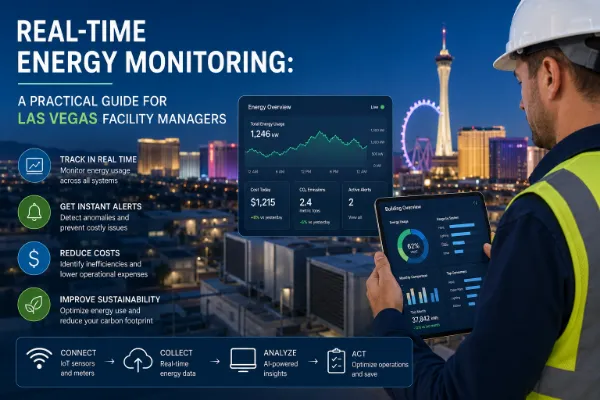
Las Vegas facility managers evaluating energy monitoring investment in 2026 are working against a genuinely different rate environment than they were even a year ago. NV Energy's new demand charge structure and shift to 15-minute interval net metering settlement, covered in more detail elsewhere on this site, mean that a monitoring system built around daily or monthly energy totals is no longer sufficient to actually manage a building's utility costs the granularity of the monitoring now needs to match the granularity of how the utility actually bills. This guide walks through how to set up energy monitoring that actually accounts for that shift.
Before evaluating monitoring hardware, pull recent utility billing data and separate it explicitly into its component parts: energy charges based on total consumption, and for any commercial account subject to demand-based billing a separate demand charge based on the single highest sustained load recorded during a specific measurement window within the billing period. This distinction matters enormously for monitoring strategy, since reducing total energy use and reducing peak demand require genuinely different interventions. A facility that runs efficiently overall but has one brief period each day where multiple large systems HVAC compressors cycling on simultaneously with a kitchen's full cooking equipment load, for instance can face a substantial demand charge despite otherwise modest total consumption, and a monitoring system focused purely on cumulative energy use would miss this entirely.
Given NV Energy's shift toward 15-minute interval settlement for net metering, and demand charges that are fundamentally about short-duration peak measurement, Las Vegas facility monitoring needs meaningfully finer time resolution than a monitoring approach built for a flat, simple rate structure would require. Submetering and circuit-level monitoring installed via current transformers should be configured to log and report at intervals matching or exceeding the utility's own settlement granularity monitoring that only reports hourly or daily averages will consistently miss the specific short-duration spikes that actually drive demand charges, even if the facility's overall energy profile looks reasonably efficient when averaged out.
For the overwhelming majority of Las Vegas commercial buildings, HVAC remains both the largest controllable energy expense and the single largest driver of demand charge risk, given how directly compressor cycling and simultaneous zone cooling can create the kind of brief, sharp load spikes that trigger demand charges. This makes HVAC circuit-level monitoring the near-universal starting point locally not just for the general energy efficiency reasons that apply in any market, but specifically because staggering compressor start times and avoiding simultaneous full-load operation across multiple units is one of the more direct, achievable ways to actively manage demand charge exposure without reducing overall comfort or operational capability.
Generic energy alerts flagging total consumption above a baseline are considerably less useful in Las Vegas's current rate environment than thresholds specifically tied to approaching a demand peak. An effective system should alert facility staff when current demand is trending toward a level that would set a new peak for the billing period, giving staff or an automated control system a window to intervene staggering equipment starts, temporarily reducing a non-critical load before the peak is actually recorded and locked in for that billing cycle. This kind of proactive, demand-aware alerting requires meaningfully more sophisticated threshold logic than a simple "usage exceeded X" alert, but it's precisely the capability that determines whether a monitoring investment actually reduces demand charge costs or just produces data that arrives too late to act on.
| Building Scenario | Typical Investment | What's Included |
|---|
| No existing BMS, wireless overlay | $0.50–$1.50 per sq ft | Circuit submetering, zone sensors, cloud dashboard |
| Existing BMS, integration and gap-filling | $0.25–$0.75 per sq ft | Bridging existing controls to a modern analytics platform |
| Demand-charge-aware alerting and automation | Varies by platform | Real-time threshold monitoring, automated load staggering |
These base hardware costs track closely with national averages, but the practical value proposition in Las Vegas specifically has shifted: where a monitoring investment case elsewhere might rest primarily on general energy efficiency savings, a Las Vegas facility's business case increasingly needs to explicitly quantify demand charge avoidance as a distinct, calculable line item, given how directly and immediately the new rate structure ties cost to short-duration peak behavior.
Facility managers new to this evaluation face the same basic choice common across markets standalone submetering hardware with a basic dashboard, versus a fuller platform bundling monitoring, demand-charge-aware alerting, and battery integration together but with a Las Vegas-specific consideration: a standalone point solution puts the burden of correctly interpreting NV Energy's new demand charge and 15-minute netting rules entirely on the facility team, a genuinely nontrivial task given how recently these rules took effect and how limited the pool of vendors with direct Nevada implementation experience remains. A bundled platform with documented Southern Nevada rate structure support built in generally costs more upfront but removes a meaningful source of configuration risk, which for most facility teams without dedicated energy analytics staff tends to be the more reliable choice despite the higher initial cost.
For Las Vegas facilities with existing or planned solar and battery installations, energy monitoring can't be treated as a separate system from battery dispatch optimization, covered in more depth elsewhere on this site the same granular, real-time load data needed to manage demand charges is also exactly what a battery dispatch system needs to make effective 15-minute-interval decisions under the new net metering rules. Facility managers evaluating monitoring platforms should specifically confirm integration capability with any existing or planned battery management system, since running these as two disconnected platforms means neither system has full visibility into the actual optimization problem the building actually faces.
- Monitoring built for the old rate structure. A platform configured around monthly net metering assumptions will misrepresent actual costs and savings opportunities under the new 15-minute interval and demand charge rules.
- Ignoring demand charge exposure entirely. Facilities that haven't historically faced significant demand charges under prior rate structures may be caught off guard by how directly the new structure ties cost to short-duration peaks, regardless of overall efficiency.
- Underestimating desert HVAC load variability. Given how dramatically Las Vegas cooling load swings between shoulder season and peak summer, monitoring thresholds calibrated during a mild period may significantly underestimate summer demand charge risk.
- Treating this as a one-time setup. NV Energy's rate structures continue evolving, and a monitoring configuration that was accurate at installation needs periodic review as both utility rates and the building's own equipment and usage patterns change over time.
For a Las Vegas facility manager evaluating this investment for the first time, a reasonable starting point is a focused pilot deployment on the single system category most likely driving demand charge exposure HVAC, in the large majority of cases rather than attempting a comprehensive, building-wide monitoring rollout immediately. Reviewing a full year of actual demand charge line items from recent utility bills, and correlating the timing of the highest recorded peaks against known building operations, often reveals a specific, addressable pattern before any new hardware gets installed at all sometimes the fastest, lowest-cost first step is simply staggering existing equipment start times based on what the utility billing data already shows, with sensor-based monitoring layered in afterward to sustain and refine that initial improvement.
Frequently asked questions
NV Energy's new demand charge structure and shift to 15-minute interval net metering settlement mean monitoring built around daily or monthly averages will miss the specific short-duration spikes that actually drive both demand charges and net metering value.
HVAC circuit-level monitoring, since compressor cycling and simultaneous zone cooling operation are typically the largest driver of the brief, sharp load spikes that trigger demand charges in Las Vegas commercial buildings.
Base hardware costs track national averages, roughly $0.50 to $1.50 per square foot for a wireless overlay system, though the business case increasingly needs to explicitly quantify demand charge avoidance given the new rate structure.
Yes, wherever both exist. The same granular load data needed for demand charge management is also what a battery dispatch system needs for effective 15-minute-interval decisions under the new net metering rules.
Calibrating alert thresholds during mild shoulder-season conditions, which can significantly underestimate actual demand charge risk once Las Vegas's extreme summer cooling load arrives.
Yes, when configured correctly. Alerts that flag demand trending toward a new peak, rather than only reporting after the fact, give staff or automated systems a window to stagger equipment or reduce non-critical load before the peak is actually recorded.
Related articles

 Energy & Sustainability