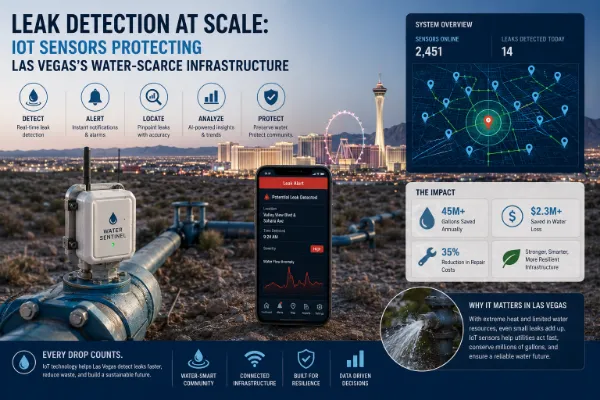
Southern Nevada draws the overwhelming majority of its water supply from Lake Mead and the Colorado River, a system that has spent much of the past two decades under drought pressure and shrinking allocation. Against that backdrop, a technology upgrade that sounds almost mundane, replacing mechanical water meters with ultrasonic ones, has quietly become one of the more consequential IoT deployments in the Las Vegas Valley. The Las Vegas Valley Water District (LVVWD) is now several years into a multi-year rollout of Advanced Metering Infrastructure (AMI), and the way that system actually works reveals a lot about how utility-grade IoT differs from the consumer smart home devices most people picture when they hear the term.
For most of LVVWD's history, water usage data was collected the way it still is in many American cities: a technician physically reads a meter roughly once a month, and a customer only discovers a leak when an unusually large bill arrives weeks after the fact. AMI changes the reporting cycle entirely. Meters transmit usage data each night to antennas positioned throughout the Valley, which relay the information back to the district. According to LVVWD Director of Customer Care JC Davis, the practical benefit is speed: the district can now see unusual consumption patterns far sooner than the old monthly-read model ever allowed, which means customers get flagged before a slow leak turns into a five-figure water bill.
The mechanics are straightforward but worth walking through, because they explain why this approach catches leaks that older systems miss entirely. Each ultrasonic meter continuously measures flow and reports it nightly rather than monthly. If the system detects sustained, unusually high water use, and the customer's contact information on file is accurate, LVVWD sends an automated text message or phone call recommending an inspection for a possible leak. That near real time detection window, hours or days rather than weeks, is the entire value proposition. A running toilet or a cracked irrigation line that would previously go unnoticed until the next billing cycle now triggers an alert while the leak is still small.
The rollout itself is a genuine engineering undertaking rather than a simple hardware swap. LVVWD is systematically upgrading older mechanical meters across its service territory to ultrasonic technology as part of a multi-year program, which the district frames as improving both metering accuracy and long-term conservation outcomes, not just leak response time. Ultrasonic meters measure flow using sound waves passing through water rather than a mechanical impeller, which means fewer moving parts to wear out and more consistent accuracy at very low flow rates, precisely the flow rates where slow leaks tend to hide.
LVVWD's meter-level detection is only half the picture. The Southern Nevada Water Authority (SNWA), the regional wholesale agency that supplies LVVWD and other member utilities, runs a parallel rebate program that pushes monitoring even closer to the source. SNWA offers a rebate covering half the purchase price of qualifying home leak sensor devices, up to two hundred dollars, for consumer products that strap around an existing water meter without requiring any pipe cutting or a licensed plumber for installation. These devices give homeowners the same kind of continuous, app-based visibility into their water use that AMI gives the utility, just at the individual property level rather than across an entire service territory.
SNWA backs this hardware incentive with a services program as well. Residential customers who find a leak they cannot fix themselves can request a leak detection voucher worth up to two hundred fifty dollars, applied toward the first diagnostic visit or two hours of repair work performed by a certified Water Smart Plumber, a network of local plumbers trained specifically in water efficiency practices through SNWA-sponsored workshops. Combining utility-side AMI alerts with homeowner-side sensors and a subsidized repair pathway creates a detection-to-resolution loop that is unusually complete for a municipal water system.
In a region where the water supply is fixed by interstate allocation agreements rather than expandable by simply drilling a new well, every gallon lost to an undetected leak is a gallon the Valley cannot recover through additional supply. That reality changes the cost-benefit math on infrastructure that might look like a minor operational upgrade in a water-rich region. A multi-year, valley-wide meter replacement program is expensive, but the alternative, continuing to rely on monthly manual reads in a service territory serving well over a million residents, means leaks routinely run for weeks before anyone notices, particularly in irrigation systems that often sit outside daily sightlines.
| Aspect | Traditional Mechanical Metering | Ultrasonic AMI Metering |
|---|
| Read frequency | Roughly once per month, manual | Nightly, automated |
| Typical leak detection lag | Weeks, until the next bill arrives | Hours to a few days |
| Customer notification | None until billing statement | Automated text or phone alert |
| Low-flow accuracy | Degrades as mechanical parts wear | Consistent, no moving parts to wear down |
- Confirm your account contact information is current with LVVWD or your local member utility. Automated leak alerts are only useful if the phone number or email on file is one someone actually monitors.
- Enroll in the utility's online customer portal to view nightly usage trends directly, rather than waiting for an alert threshold to trigger, particularly useful for multifamily properties with shared irrigation systems.
- Apply for SNWA's smart device rebate for common-area or model-unit water sensors where eligible, since the fifty percent or two-hundred-dollar rebate applies to qualifying consumer devices beyond single-family homes in many cases.
- Budget for a Water Smart Plumber relationship in advance rather than searching for one during an active leak, since only work performed by a certified provider on that list qualifies for the leak detection voucher.
Commercial and industrial water customers, including resorts running large-scale irrigation and cooling systems, casinos with extensive landscaping, and multifamily complexes with shared plumbing, stand to benefit even more than single-family homeowners from this shift, simply because the dollar value of an undetected leak scales with property size. A slow leak in a single-family home might waste a few hundred gallons a day before it is caught. The same undetected leak in a resort's irrigation main or a large apartment complex's shared riser can waste tens of thousands of gallons before a monthly bill reveals the problem, and at commercial water rates that translates directly into avoidable operating cost. Facilities teams that treat AMI data as a passive utility service rather than an active operations input are leaving a genuinely useful monitoring layer unused. Pulling nightly consumption data into an existing building management or facilities dashboard, rather than only checking it after a billing dispute, turns a compliance-oriented utility feed into a genuine operational tool.
Retrofitting meters across an entire metropolitan service territory is logistically demanding, and a multi-year timeline means some neighborhoods will have ultrasonic meters years before others, creating uneven leak-detection coverage across the Valley in the meantime. False positive alerts are another real friction point: a large one-time event like filling a pool or running a sprinkler system for an unusually long cycle can trigger an unnecessary alert, and utilities have to tune thresholds carefully to avoid alert fatigue that leads customers to ignore notifications altogether. There are also edge cases worth knowing about directly: SNWA explicitly warns that improperly installing a consumer leak sensor near a home's automatic fire sprinkler system can interfere with that system's operation, which is exactly the kind of interaction that only becomes visible once a technology moves from pilot to mass deployment. Finally, the entire alert system depends on accurate customer contact information on file, an unglamorous administrative detail that determines whether a genuinely sophisticated detection system actually reaches anyone when it matters.
The logical next step is tighter integration between water data and other utility data streams. NV Energy's own smart meter network, discussed in more detail in our coverage of the region's electric grid modernization, already collects granular consumption data across more than a million endpoints, and a combined utility dashboard showing water and power usage side by side is a realistic near-term possibility as both systems mature. Expect continued expansion of the ultrasonic meter replacement program, deeper use of SNWA's conservation rebate structure as drought contingency planning remains a permanent feature of Colorado River management rather than a temporary response, and growing interest from commercial and multifamily property owners in portfolio-wide monitoring tools that aggregate AMI data across many accounts rather than checking usage one property at a time. Companies building or integrating those tools can find regional partners through the Las Vegas IoT companies directory, and ongoing coverage of related infrastructure projects is tracked in the site's Internet of Things section.
Frequently asked questions
AMI refers to ultrasonic water meters that transmit usage data nightly to antennas across the Las Vegas Valley, which relay it back to the Las Vegas Valley Water District. This replaces the old model of manual monthly meter reads and allows the district to flag unusual usage within hours or days instead of weeks.
If the AMI system detects sustained unusually high water use and the customer's contact information is accurate, LVVWD sends an automated text message or phone call recommending an inspection for a potential leak, well before the issue would show up on a monthly bill.
The Southern Nevada Water Authority offers a rebate covering fifty percent of the purchase price, up to two hundred dollars, for qualifying home leak sensor devices that strap around an existing water meter without requiring pipe cutting or professional installation.
A Water Smart Plumber is a plumber trained in water efficiency practices through SNWA-sponsored workshops. Residential customers with an unresolved leak can request a voucher worth up to two hundred fifty dollars, applied toward the first diagnostic visit or two hours of repair performed by one of these certified plumbers.
Southern Nevada's water supply is fixed by interstate Colorado River allocation agreements rather than expandable through new sources, so undetected leaks represent water the region cannot simply replace. Catching leaks within hours instead of weeks has an outsized impact on regional conservation goals.
SNWA specifically warns that improperly installing a leak sensor near a home's automatic fire sprinkler system can interfere with the sprinkler system's operation, an interaction property owners should check for before installing a device themselves.
Related articles

 Smart Utilities