On October 1, 2017, officers responding to the deadliest mass shooting in modern U.S. history needed a way to document an enormous outdoor crime scene, the Route 91 Harvest festival grounds, without spending days photographing it section by section. At the FBI's request, the Las Vegas Metropolitan Police Department flew drones over the site to map it in far less time than ground-based documentation would have taken. That single deployment became the origin point for what is now one of the most aggressive drone programs of any police department in the country, and it is worth understanding in detail because it shows how a public safety technology investment can go from emergency improvisation to standard daily infrastructure in less than a decade.
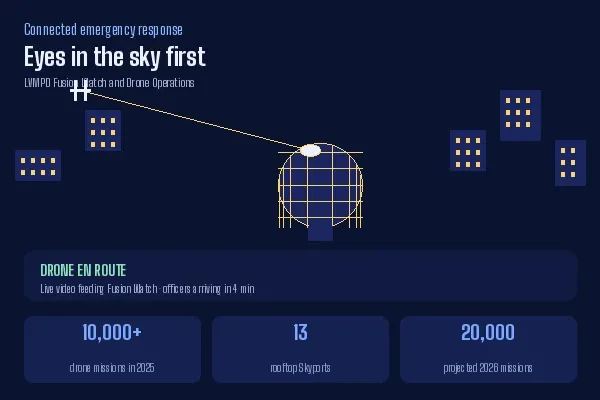
By 2025, LVMPD was flying more than ten thousand drone missions annually, reportedly the highest volume of any public agency in the nation, and these were not training exercises. Each flight was an active response to a call for service, providing real time intelligence to officers on the ground. In January 2026, the department unveiled a significantly expanded version of that capability: a Fusion Watch and Drone Operations Center at Metro headquarters, paired with thirteen rooftop "skyport" launch pads positioned around the valley. Drones can now be launched remotely from these skyports and flown up to two miles away, operated entirely from dispatchers sitting inside the Fusion Center rather than requiring an officer to physically deploy hardware on scene. With the skyport network fully operational, the department was averaging roughly 1,700 flights per month as of early 2026, with sheriff Kevin McMahill projecting the pace could roughly double to approximately 20,000 missions for the year.
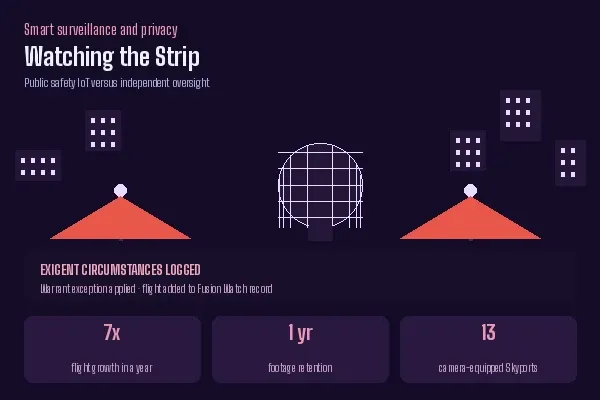
The underlying hardware reflects a genuine engineering investment rather than a symbolic gesture. The docked drone fleet includes AI-based collision avoidance, thermal imaging for locating people in low visibility conditions, and parachute systems designed to deploy safely if a drone experiences an unplanned landing over a populated area. Every flight is tied to a specific, logged public safety response and is deconflicted and audited under department policy, a detail LVMPD emphasizes explicitly given the understandable civil liberties questions that come with a rooftop-launched aerial surveillance network covering an entire metro area.
Drones are the most visible piece of LVMPD's technology buildout, but they sit on top of a broader sensor and detection network. Department resources cited in a federal community policing report describe a system that includes roughly 125 automated license plate readers, 24.5 square miles of ShotSpotter gunshot detection coverage, 235 facility cameras, and a network of camera trailers that can be repositioned to specific locations as needed. A stolen vehicle hit from an automated license plate reader, for example, triggers an alert inside the Fusion Watch Center in real time, the same alarm-and-alert workflow reporters observed during the center's January 2026 unveiling. The department has also built a program called Vegas SafeCam that invites both businesses and residents to voluntarily register private camera systems, giving investigators a much larger pool of potential video evidence for a given incident without the city needing to install and maintain that hardware itself.
The most operationally interesting piece of this system is the planned link between ShotSpotter's audio-based gunshot detection and the drone network. ShotSpotter uses acoustic sensors and computer analysis to triangulate the location of gunfire and report coordinates to police within seconds. LVMPD leadership has described a model where a confirmed ShotSpotter alert automatically cues the nearest pre-positioned drone to respond, with the department's stated goal of getting a drone overhead within roughly thirty seconds of an alert, well before a patrol car could reasonably arrive at many locations across the valley. Given that department leadership has publicly stated that a relatively small number of chronic hotspot areas account for a large share of the crimes reported valley-wide, concentrating rapid aerial response capability specifically around those repeat locations is a deliberate resource allocation choice rather than a blanket surveillance strategy.
| System | What It Does | Scale in the Las Vegas Valley |
|---|
| Docked drone network | Remote launch from rooftop skyports, AI collision avoidance, thermal imaging | 13 skyports, over 10,000 missions in 2025, projected up to 20,000 in 2026 |
| Automated license plate readers | Flags stolen vehicles and vehicles of interest in real time | Approximately 125 ALPR units citywide |
| ShotSpotter gunshot detection | Acoustic triangulation of gunfire location within seconds | 24.5 square miles of coverage concentrated in chronic crime hotspots |
| Vegas SafeCam | Voluntary registration of private camera systems for investigative access | Growing network of business and residential participants |
The scale of LVMPD's buildout is easier to understand against the backdrop of what the department is actually policing. Las Vegas absorbs tens of millions of visitors a year across a relatively compact tourist corridor, hosts some of the largest recurring outdoor events in the country, and has a documented history of needing to coordinate a mass casualty response on short notice. That combination creates sustained institutional pressure, and a correspondingly sustained budget case, for exactly the kind of rapid-response aerial and sensor infrastructure most mid-size American police departments would struggle to justify. A tourist-driven economy this large also means major resorts and event organizers already operate extensive private security and camera infrastructure of their own, which is precisely the pool of potential partners the Vegas SafeCam program is designed to tap into rather than duplicate.
Police departments in other jurisdictions have taken notice specifically of the drone-to-gunshot-detection concept, since it represents a genuinely novel integration rather than simply buying more of an existing technology category. Most cities running ShotSpotter treat it purely as an alerting system that sends coordinates to a dispatcher who then routes a patrol unit. LVMPD's model treats the alert as a trigger for an automated aerial response that can arrive before a ground unit in many cases, particularly across a valley with the kind of low-density residential and commercial sprawl common throughout the Southwest. Whether that response time advantage holds up under wider deployment and produces a measurable public safety benefit relative to the civil liberties tradeoffs is likely to become one of the most closely tracked open questions in American policing technology over the next several years.
- Register eligible camera systems with Vegas SafeCam if your property sits near a known crime hotspot, since this directly expands the investigative footprint available to LVMPD without requiring any changes to your existing security setup.
- Understand that ALPR alerts operate in real time, which matters for parking operators and property managers coordinating with law enforcement on stolen vehicle recovery or trespass enforcement.
- Factor drone response capability into major event security planning, since large venues and event organizers can coordinate directly with Metro on aerial monitoring for crowd safety during high-attendance gatherings.
- Track the civil liberties debate around this technology, since UNLV research cited by the department has found mixed public opinion, with residents generally supportive of drones searching for suspects but more skeptical of using the same technology to monitor crowds at protests or large gatherings.
Balancing genuine public safety value against surveillance concerns is the central tension running through nearly every part of this system, and it is not one LVMPD can fully resolve through technology policy alone, since public trust depends as much on transparency and consistent enforcement of usage rules as on the underlying hardware. Cost is a related constraint: a docked drone fleet, thirteen skyports, and a dedicated operations center represent a substantial and ongoing capital and staffing commitment for a single department, one that smaller municipalities within the same metro area may struggle to replicate independently. Integration between newer AI-driven systems and older infrastructure, such as legacy camera networks and years of accumulated ALPR data, also requires continuous technical maintenance rather than a one-time buildout. Finally, the entire drone triangulation concept depends on ShotSpotter's underlying acoustic accuracy, and any false positive or missed detection in that layer propagates directly into wasted or misdirected aerial response.
Expect the ShotSpotter-to-drone automation to mature from a stated goal into routine daily operation as the skyport network expands its coverage footprint across the valley. Facial recognition software is another capability department leadership has publicly discussed layering onto the existing camera and drone infrastructure, a development likely to intensify the same civil liberties debate already surrounding the current system. As Sheriff McMahill's stated ambition to build the most technologically advanced police department in the country continues, other jurisdictions watching the drone-to-gunshot-detection model closely are likely to attempt similar integrations, making Las Vegas a genuine testbed for this category of public safety technology rather than simply an early adopter. Businesses and integrators working in this space can find regional partners through the Las Vegas IoT companies directory, and ongoing coverage is tracked in the site's Public Safety section.
Frequently asked questions
The program traces back to October 1, 2017, when the FBI requested that LVMPD use drones to map the Route 91 Harvest festival crime scene after the mass shooting. That single deployment demonstrated the value of aerial mapping and led directly to the creation of a formal drone program.
Unveiled in January 2026, it is a centralized facility at LVMPD headquarters where dispatchers can remotely launch and operate drones from thirteen rooftop skyports positioned around the Las Vegas Valley, monitor real time camera feeds, and receive automated license plate reader alerts.
ShotSpotter uses acoustic sensors to triangulate gunfire locations within seconds. LVMPD's stated goal is to automatically cue the nearest pre-positioned drone to respond to a confirmed alert, aiming to get a drone overhead within roughly thirty seconds.
Vegas SafeCam is a voluntary program that lets businesses and residents register their private camera systems with LVMPD, giving investigators access to a larger pool of potential video evidence for investigations without the department needing to install additional hardware.
LVMPD flew more than 10,000 drone missions in 2025, the highest volume of any public agency in the nation. With the expanded skyport network, the department was averaging about 1,700 flights per month in early 2026 and projected up to 20,000 missions for the year.
Civil liberties and surveillance concerns are the central issue, particularly around using drones to monitor crowds at protests or large gatherings. UNLV research cited by the department found residents generally support drones searching for suspects but are more skeptical of crowd monitoring use cases.
Related articles

 Public Safety