A Las Vegas Strip resort never really has a quiet maintenance window. There's no 2 a.m. closure to run a system update, no slow season to schedule a major retrofit around the casino floor, the hotel tower, the convention space, and the restaurants all operate continuously, every day of the year, which makes smart building IoT in this market a fundamentally different engineering problem than it is almost anywhere else. Building management technology here has to work invisibly, in real time, around guests and gaming revenue that literally never stops.
A large Strip property's technology environment can interface with 20 or more discrete software systems running simultaneously, layered in a way that's specific to the resort-casino business model. The property management system sits at the foundation, handling room inventory, reservations, check-in, billing, and housekeeping dispatch, communicating in real time with a central reservations system and revenue management algorithms that dynamically adjust room rates based on demand, competitor pricing, and historical booking patterns. Above that sits the casino management system, tracking player activity on the gaming floor and feeding data into loyalty program accounts. Point-of-sale platforms, ticketing infrastructure for entertainment, and convention services platforms round out the stack, tied together through enterprise service bus architectures or API gateway layers that let, for example, a guest's restaurant spend automatically credit their loyalty tier and adjust their comp-eligible status in the casino system without any manual reconciliation.
Here's what genuinely sets Las Vegas apart from every other smart building market covered elsewhere on this site: any software touching gaming data operates under Nevada Gaming Control Board Technical Standards, which specify exact data formats and audit trail requirements. Practically, this means any upgrade to a system that touches gaming data even something that might seem purely like a building automation change has to clear a formal recertification process before it can go live. This adds a genuinely unique layer of friction to smart building deployment in Las Vegas that a hotel or office building anywhere else in the country simply doesn't have to navigate. A facilities team can't treat casino-adjacent IoT the way they might treat a straightforward HVAC sensor upgrade in a typical commercial building; anything with even indirect proximity to gaming systems needs to be scoped with this regulatory review in mind from the design stage, not bolted on as an afterthought.
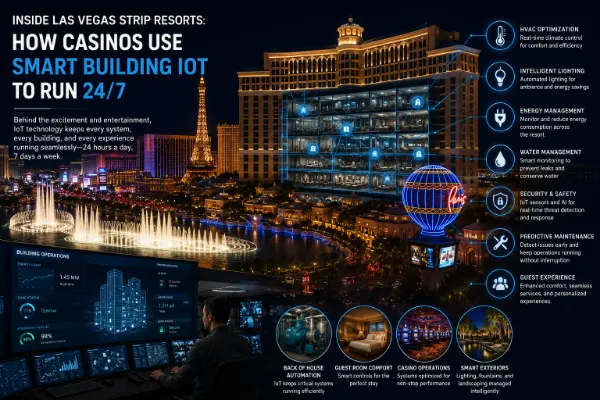
The concept of a "cognitive building" one that adapts lighting, HVAC, and ventilation based on real-time occupancy and activity has particular relevance on a Strip casino floor, where motion sensors already detect guest movement to provide live occupancy data used for security, analyzing which games are drawing the most engagement, and informing machine layout decisions. Beyond the immediately visible security and layout applications, this same real-time occupancy data increasingly feeds into environmental control: dynamically adjusting HVAC and lighting based on how densely a specific section of the floor is actually being used at a given hour, rather than running every zone at a fixed baseline regardless of whether it's packed or nearly empty. Given how enormous a Strip casino floor's energy footprint is climate control alone across a property this size represents a massive, continuous cost even modest, occupancy-driven efficiency gains compound into meaningful savings at this scale.
Las Vegas Sands' energy and water efficiency upgrades across The Venetian, The Palazzo, and the Sands Expo and Convention Center earned recognition from the U.S. Department of Energy's Better Buildings Challenge a genuine, third-party-verified example of what continuous IoT-driven facility management can deliver at Strip scale, rather than just marketing language. This kind of program depends on facility management becoming more proactive and evidence-based, using IoT data and AI to shift from reactive maintenance toward predictive, data-informed decisions across the property's massive mechanical and electrical infrastructure.
Beyond back-of-house building management, guest-facing smart room technology has become a genuine differentiator, particularly for boutique and downtown properties competing against megaresort scale with a more personalized guest technology experience. Downtown Grand Hotel & Casino, for instance, standardized its infrastructure on wireless access points with built-in Bluetooth Low Energy beacons specifically to enable location-based services and IoT capability throughout guest rooms and outdoor event spaces, without running additional cabling for each new device category added later. This kind of open, multivendor infrastructure approach rather than a single proprietary smart-room platform gives a property flexibility to add new guest technology over time without a disruptive, ground-up system replacement each time.
It's a genuinely telling sign of Las Vegas's position in commercial smart building technology that Cisco Live, one of the industry's premier networking and connected infrastructure conferences, is held annually at the Mandalay Bay Convention Center a venue that is itself a working example of the exact large-scale smart building technology the conference showcases. Vendors demonstrating power-over-ethernet lighting, intelligent shading, occupancy-based automation, and centralized building controls are doing so inside a building running some version of that same technology stack, giving Las Vegas a uniquely self-referential role as both a showcase venue and a genuine deployment environment for the commercial smart building industry.
Beyond the recertification process itself, Strip properties face a genuinely elevated cybersecurity bar for any IoT system that sits anywhere near gaming infrastructure, given the direct financial stakes involved and the sophistication of threats targeting casino networks specifically. Building management systems, even when not directly touching gaming data, typically need to be network-segmented from casino management infrastructure as a matter of both regulatory expectation and basic security hygiene a building automation sensor compromised through a weak default password shouldn't represent a pathway into systems handling real-money transactions. This segmentation requirement adds real engineering overhead to what might otherwise be a straightforward smart building deployment in a non-gaming commercial property, and it's a genuine reason Strip properties often favor established vendors with documented experience in gaming-adjacent environments over newer entrants without that specific track record.
For a Strip property's facilities and IT leadership evaluating new smart building investment, the practical sequencing looks different than it would for a typical commercial building specifically because of the 24/7 operational constraint and the gaming regulatory overlay. Any new deployment needs a rollout plan that doesn't require taking systems offline during operating hours which, on the Strip, is essentially always and any system with potential proximity to gaming data needs its regulatory recertification pathway scoped before a vendor contract is even signed, not discovered mid-deployment when a compliance review unexpectedly halts a rollout already underway.
Frequently asked questions
A large property can interface with 20 or more discrete systems simultaneously, spanning property management, casino management, point-of-sale, ticketing, and convention services platforms, all connected through integration middleware.
Nevada Gaming Control Board Technical Standards require any software upgrade touching gaming data to clear a formal recertification process before deployment, adding a unique layer of regulatory review that doesn't exist for smart building technology in other commercial markets.
Motion sensors detect guest movement to support security, analyze which games draw the most engagement, inform machine layout decisions, and increasingly drive dynamic HVAC and lighting adjustments based on real-time floor density.
Yes. Las Vegas Sands earned recognition from the U.S. Department of Energy's Better Buildings Challenge for energy and water efficiency upgrades across The Venetian, The Palazzo, and the Sands Expo and Convention Center.
The conference is hosted at the Mandalay Bay Convention Center, a venue that itself demonstrates large-scale smart building technology, giving Las Vegas a distinctive dual role as both a major technology conference destination and a real-world deployment environment.
Properties operate continuously with no scheduled downtime, and any system with potential proximity to gaming data requires regulatory recertification, both of which need to be planned for from the outset rather than addressed after a rollout has already begun.
Related articles

 Smart Buildings